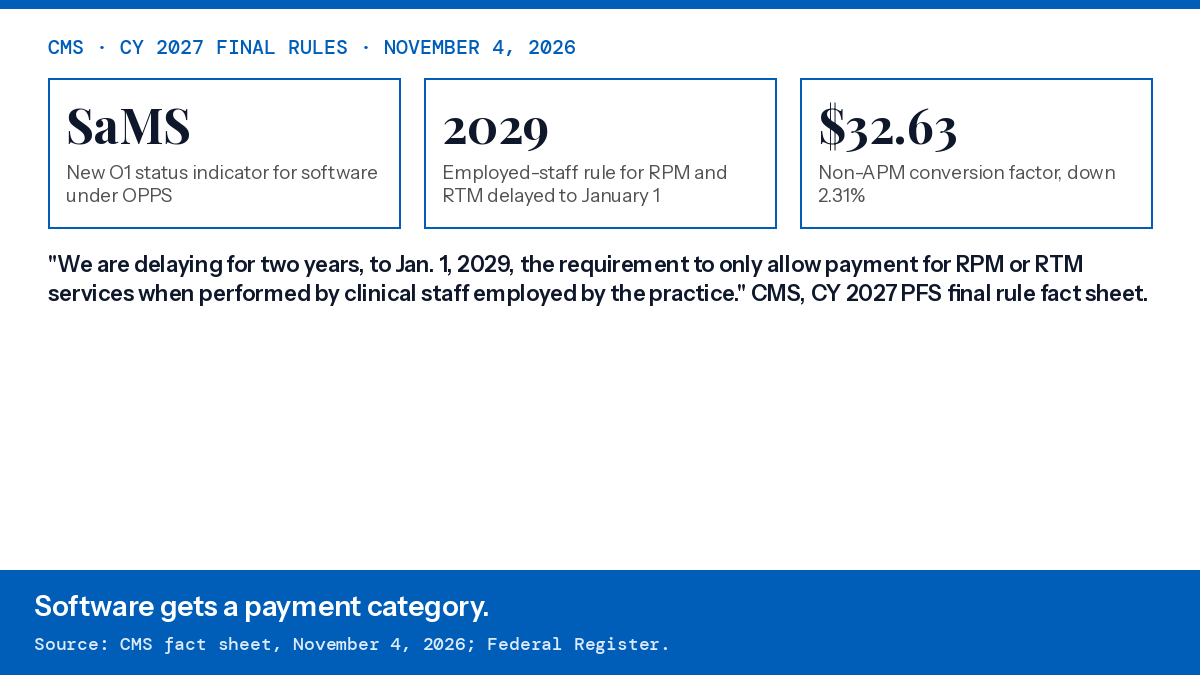
Medicare has paid for software in pieces for years: a code here, a bundled service there, a lab fee schedule for algorithmic analyses that never fit the lab label. On November 4, in its CY 2027 final rules, CMS did something different. In the outpatient rule it gave this category a name, Software as a Medical Service, and a dedicated status indicator, O1. In the physician fee schedule it kept remote monitoring payable and pushed the toughest staffing restriction out to 2029. And it did so while cutting the conversion factor.
This deep dive reads the rules as a buyer and a builder would: what is final, what is interim, what is explicitly left open, and where the evidence in other HealthTech stories, such as voice monitoring in heart failure, meets the payment system.
SaMS is an interim policy tied to current rates. The category now has a name; the long-term way CMS will pay for software does not yet.
In This Deep Dive
- Why this matters now
- What actually happened
- The obvious read versus the deeper signal
- Category map and taxonomy
- Evidence Ladder
- Regulation, FDA interplay and rulemaking calendar
- Capital flows and bottom-up economics
- The HealthTech Investor's Signal
- Evidence boundaries
- Forward Intelligence
- The Bottom Line for Digital Health Vendors and Provider Finance Leaders
Why this matters now
Digital health companies have struggled with a basic question: when software does clinical work, who pays and under what code? Billing for AI-supported diagnosis, algorithmic analyses and monitoring has relied on workarounds. A named payment category does not solve that, but it gives vendors and hospitals a place to point and gives CMS a place to refine.
The remote monitoring rule matters because RPM and RTM are the main reimbursement routes for connected care. CMS proposed four changes for 2027: RTM only for established patients, a separately reportable initiating visit, updated valuation and an employed-staff requirement that would end payment when contractors performed the services. It finalized the first three and delayed the fourth for two years, to January 1, 2029. Vendors with contractor-staffed models gained time, not a permanent exemption.
The money side matters because the same fee schedule that pays for clinician time is shrinking. CMS says the qualifying APM conversion factor is $32.95, a projected decrease of $0.62 or 1.83% from $33.57, and the non-qualifying factor is $32.63, down $0.77 or 2.31% from $33.40. CMS attributes the cut to the expiration of the one-year 2.50% increase for 2026 plus an estimated 0.12% adjustment for work RVU changes, partly offset by statutory updates of 0.75% and 0.25%.
For heart failure monitoring specifically, the rules neither create nor remove a path for voice-based tools. A voice monitoring product that does not fit the device-based definition of remote physiologic monitoring may have no obvious code today; coding advice should come from a qualified billing expert. That is why we pair this note with our DETECT-HF analysis: detection evidence and payment rules are on different tracks, and vendors in that space should watch the ACCESS model's heart failure track, starting April 1, 2027, as a possible alternative route.
Certainty: (A) all numbers and policies in this section from the CMS PFS fact sheet and the OPPS rule text; (B) our reading that a named category helps buyers and vendors; (C) none of this is legal or coding advice.
What actually happened
- Release date: November 4, 2026. CMS issued the CY 2027 PFS final rule and the OPPS final rule with comment period the same day, per its fact sheet and newsroom.
- Federal Register: OPPS (CMS-1850-FC) printed from 91 FR 70284 on November 6, 2026; PFS (CMS-1848-F) published November 9, 2026 at 91 FR 70992. Provisions are effective January 1, 2027; OPPS comments are due January 4, 2027.
- SaMS terminology: CMS finalizes Software as a Medical Service as the term for this group of services under Medicare payment.
- SaMS payment: As an interim policy while CMS considers a longer-term method, SaMS technologies are assigned to new technology APCs with rates that closely align with CY 2026 rates, using new status indicator O1 (Software as a Medical Service, paid under OPPS; separate APC payment).
- Algorithmic analyses: CMS moves stand-alone algorithmic analyses of prior lab test data, such as secondary genomic sequencing analyses, from the Clinical Laboratory Fee Schedule to OPPS as other diagnostic tests.
- FDA relationship (final rule responses): In responses to commenters, CMS says SaMS analyses performed on laboratory tests would not currently require FDA marketing authorization to receive OPPS payment, and SaMS that receive clearance outside the rulemaking cycle go through normal quarterly coding processes.
- Remote monitoring: Finalized for 2027: RTM only for established patients, a separately reportable initiating visit and updated valuation. Delayed to January 1, 2029: payment only when clinical staff are employed by the practice. Bundling RPM and RTM codes into four new HCPCS G-codes was not finalized and may be considered later.
- Conversion factors: $32.95 qualifying APM ($33.57 prior, down 1.83%); $32.63 non-qualifying ($33.40 prior, down 2.31%).
- OPPS update: CMS estimates finalized OPPS policies raise payments by 1.7%, about $1.78 billion across roughly 3,600 facilities, before enrollment, utilization and case-mix changes.
- Leadership: Dr. Mehmet Oz is the 17th CMS Administrator, per the CMS leadership page.
- What this is not: It is not a permanent payment methodology for software, not a coverage decision for any specific product and not a change to FDA authorization requirements.
Certainty: (A) all items above from the CMS fact sheet, the Federal Register record and the OPPS rule text; (B) the FDA relationship items come from CMS responses to commenters, which can be read narrowly; (C) the final box is our framing.
The obvious read versus the deeper signal
The obvious read: Medicare finally pays for AI software, and remote monitoring got a reprieve, so digital health vendors can plan on stable reimbursement.
The deeper signal: SaMS is interim, rate-anchored to 2026 and limited to the outpatient setting through OPPS, while the physician fee schedule is cutting the conversion factor. The remote monitoring delay is two years, not repeal, and the other three restrictions begin in 2027. The signal is that CMS wants to define and then discipline the category, not that it has settled the long-term price of software.
Certainty: (A) the interim and 2029 facts; (B) the interpretation that CMS wants to define and then discipline the category; (C) the commercial implications for any given vendor.
Historical playbook
Medicare payment has long lagged technology. Software-based diagnostics were paid through lab fees when they resembled tests, through imaging codes when attached to scans, and often not at all when they only supported a clinician. Remote monitoring followed its own path: codes were created over the past decade, and CMS has used recent rulemaking to tighten definitions and valuation.
The pattern is familiar. A new payment category appears, usage grows, and the agency adds guardrails. SaMS and the 2027 RPM and RTM rules sit at two different points on that curve: SaMS at the start, with an interim policy and rates held near current levels, and remote monitoring in a tightening phase with established-patient and initiating visit requirements arriving in 2027.
Another recurring pattern is that rules finalized in early November are only the first act. Sub-regulatory guidance, quarterly updates and coding clarifications follow, and the details often decide who benefits. Readers should treat this deep dive as a map of the structure, then read the Federal Register text and CMS files for the codes and rates relevant to their products.

Software windows connect administrative records and clinical workflows. Existing editorial illustration of healthcare information processing.