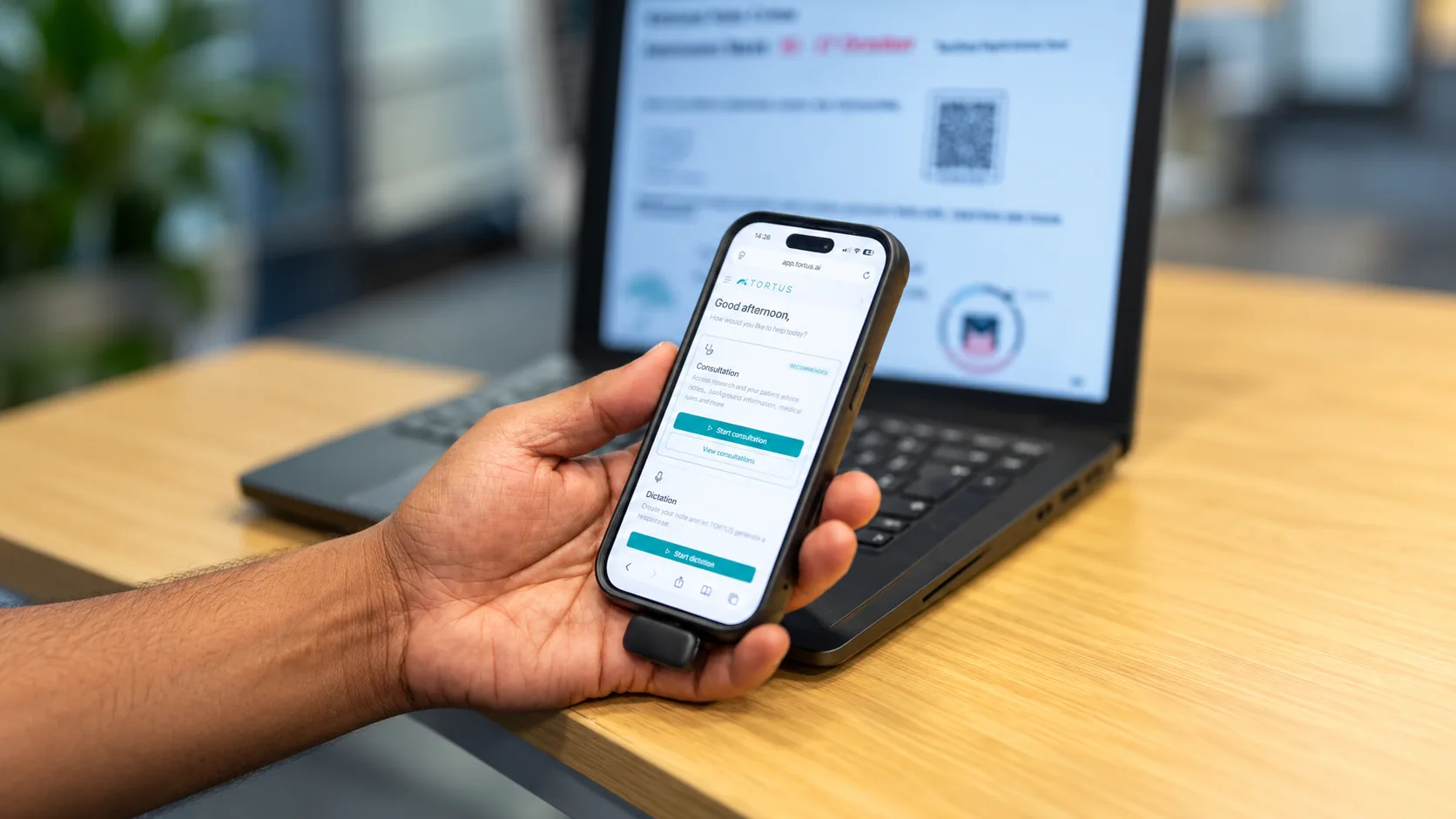

A med-surg nurse on a busy day shift might be responsible for five or six patients, each with assessments, medications, wound care and changes that need to be charted in structured flowsheets. Much of the documentation happens after the care, at a workstation, from memory. Ambient AI promises to capture what the nurse says at the bedside and file it in the right place. The problem is that a nurse's work does not look the same on every unit, and a tool that works on one ward can fail on the next.
That is the gap Microsoft is trying to close with Dragon Copilot 6.0, published on November 18. Below we set out what is generally available and what is still in preview, why training and oversight are the real substance of the release, which rules apply to the data it creates, and what nursing and informatics leaders should ask before moving beyond a pilot unit.
The free story is a product update. The world around it is the question every nursing AI deployment faces: can it scale on controls, not on a demo?
In This Deep Dive
- Why this matters now
- What actually happened
- The obvious read versus the deeper signal
- Historical playbook
- The world forming around nursing documentation AI
- Category map and taxonomy
- Evidence Ladder
- Regulation: decision support rules, certified health IT and the data Fabric export creates
- Capital flows and bottom-up economics
- The HealthTech Investor's Signal
- Counter-thesis
- Forward Intelligence
- The Bottom Line for Chief Nursing Officers, Nursing Informatics Leaders and Health IT Investors
Why this matters now
Physician ambient documentation has moved quickly from pilots to system-wide rollouts. Nursing is harder. Nurses document far more structured data than physicians, much of it in flowsheets with customer-specific rows, and the work varies sharply between emergency, med-surg, progressive care, critical care and pediatrics. A tool that only fills one template for one setting cannot become standard practice across a hospital.
Microsoft says its goal is to help organizations bring AI to more nursing workflows without asking every nurse or every unit to work the same way. That is the right framing, because nursing leaders are the people who have to sign off on accuracy, training and accountability across dozens of units. The release is mostly about giving them the tools to do that.
The timing also matters. Microsoft is extending Dragon Copilot just as nursing leaders are being asked to absorb more AI tools into workflows that are already stretched. Products that reduce training burden and make accuracy visible have a better chance of surviving that scrutiny than products that only promise time savings.
Certainty: (A) Microsoft's stated goal and release contents are from its November 18 blog; (B) the comparison with physician ambient documentation is our interpretation.
What actually happened
- General availability: Med-surg nursing templates are generally available. Nursing data export to
Microsoft Fabric is generally available, with continuous export of nursing transcripts and audio recordings to the customer's configured Fabric environment.
- Public preview: Any care settings, any flowsheets and multiple clinical roles. Customers create flowsheet profiles that give the AI the context to extract information into the right templates for different settings and workflows.
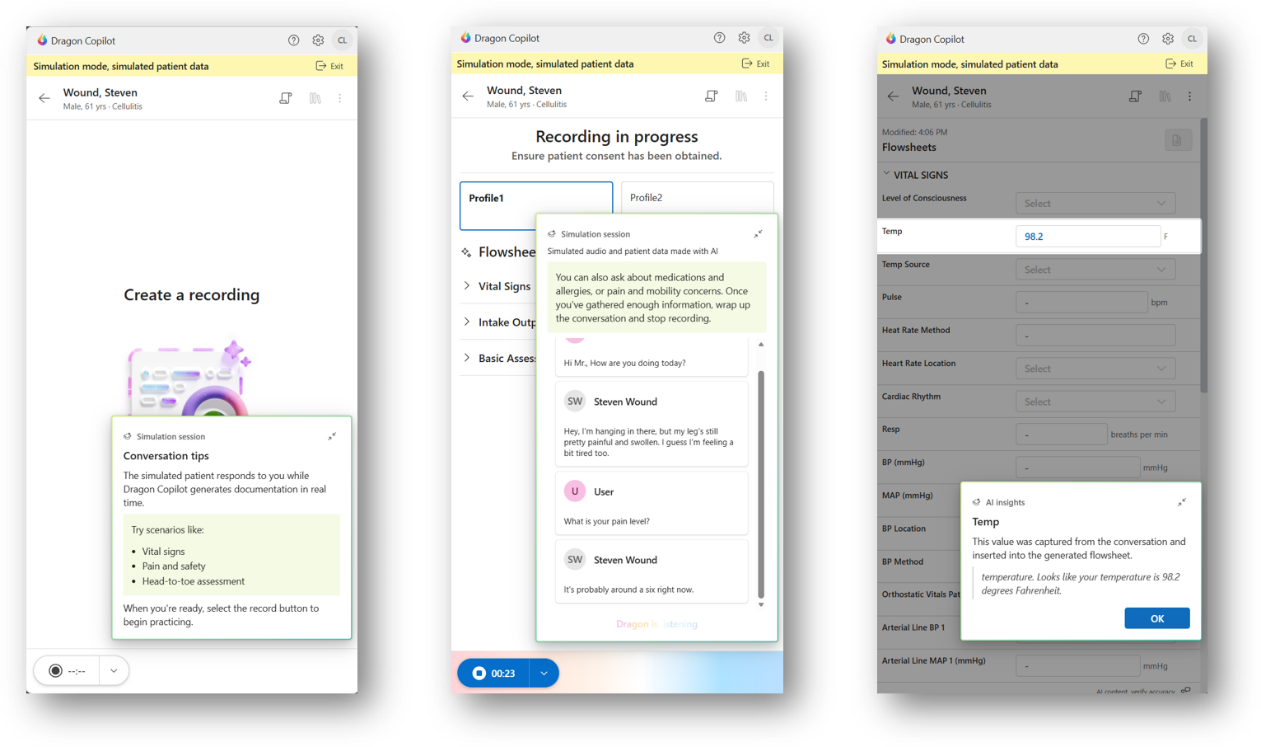
- Training: Simulation mode, in public preview, uses predefined synthetic AI patients without real patient data or live clinical systems. Nurses practice speaking their care out loud and see how Dragon Copilot turns their verbal assessment into documentation. AI insights show the transcript evidence behind extracted flowsheet values.
- Oversight: Expanded nursing analytics in the Dragon admin center add reporting by language, session mode, user type and practitioner qualification, and separate simulation from production activity. Session review, in public preview, lets informatics teams compare what the system extracted with what the nurse corrected and turn a correction into a test case.
- Context and limits: Dragon Copilot with Work IQ, when enabled, brings in organizational resources, care team information and permitted

Certainty: (A) every item above is from Microsoft's November 18, 2026 blog and the Dragon Copilot 6.0 release notes on
Microsoft Learn.
Microsoft did not publish accuracy figures for public preview settings.
The obvious read versus the deeper signal
The obvious read: Microsoft added more nursing templates and some training features. On this reading the release is incremental and the important number is how many hospitals buy it.
The deeper signal: The more important change is that Microsoft is productizing the controls that let a nursing leader expand safely: a practice environment before go-live, transcript evidence behind every extracted value, analytics that separate training from real use, and a loop that turns nurse corrections into test cases. Those features address the main reason nursing AI stalls after a pilot, which is that leaders cannot see whether it is accurate enough in a new setting. At the same time, the split between general availability for med-surg and public preview for everything else is a clear statement of where
Microsoft itself considers the product proven.
Certainty: (B) evidence-based interpretation of the release structure; Microsoft has not published adoption or accuracy data by setting.
Historical playbook
Microsoft's position in clinical documentation comes from
Nuance, which it acquired in 2022.
Nuance's Dragon dictation products were already widely used by physicians, and
Microsoft later combined dictation and ambient capture under the Dragon Copilot name. The pattern from physician ambient documentation is instructive: early deployments focused on a single specialty or clinic type, and expansion depended on showing clinicians that note quality held up in their own setting. Nursing is following the same path, starting with med-surg.
The older lesson comes from the shift to electronic records itself. When hospitals moved nursing documentation into EHR flowsheets, the volume of structured data nurses had to enter grew, and documentation burden became one of the most cited sources of nursing frustration. Tools that promise to reduce that burden are judged against that history, which is why training, review and accountability matter as much as capture accuracy.
The world forming around nursing documentation AI
Several actors are converging on the same problem. EHR vendors are adding their own AI assistants inside the record, which puts native tools in competition with partner products like Dragon Copilot. Physician ambient scribe companies are extending their products toward nursing and other clinical roles. Health systems are investing in virtual nursing models that change who documents what, and where. Microsoft's dependence on Epic Rover for recording shows how closely any nursing AI has to fit the EHR's own mobile workflow.
Microsoft is also building out its own model stack. The release names MAI Realtime 1, a speech-to-speech model built by
Microsoft, as the engine behind simulation mode, and Dragon Copilot with Work IQ connects nursing questions to
Microsoft 365 content. That suggests
Microsoft sees nursing documentation as one entry point into a wider set of workplace AI tools inside hospitals, not a standalone product.