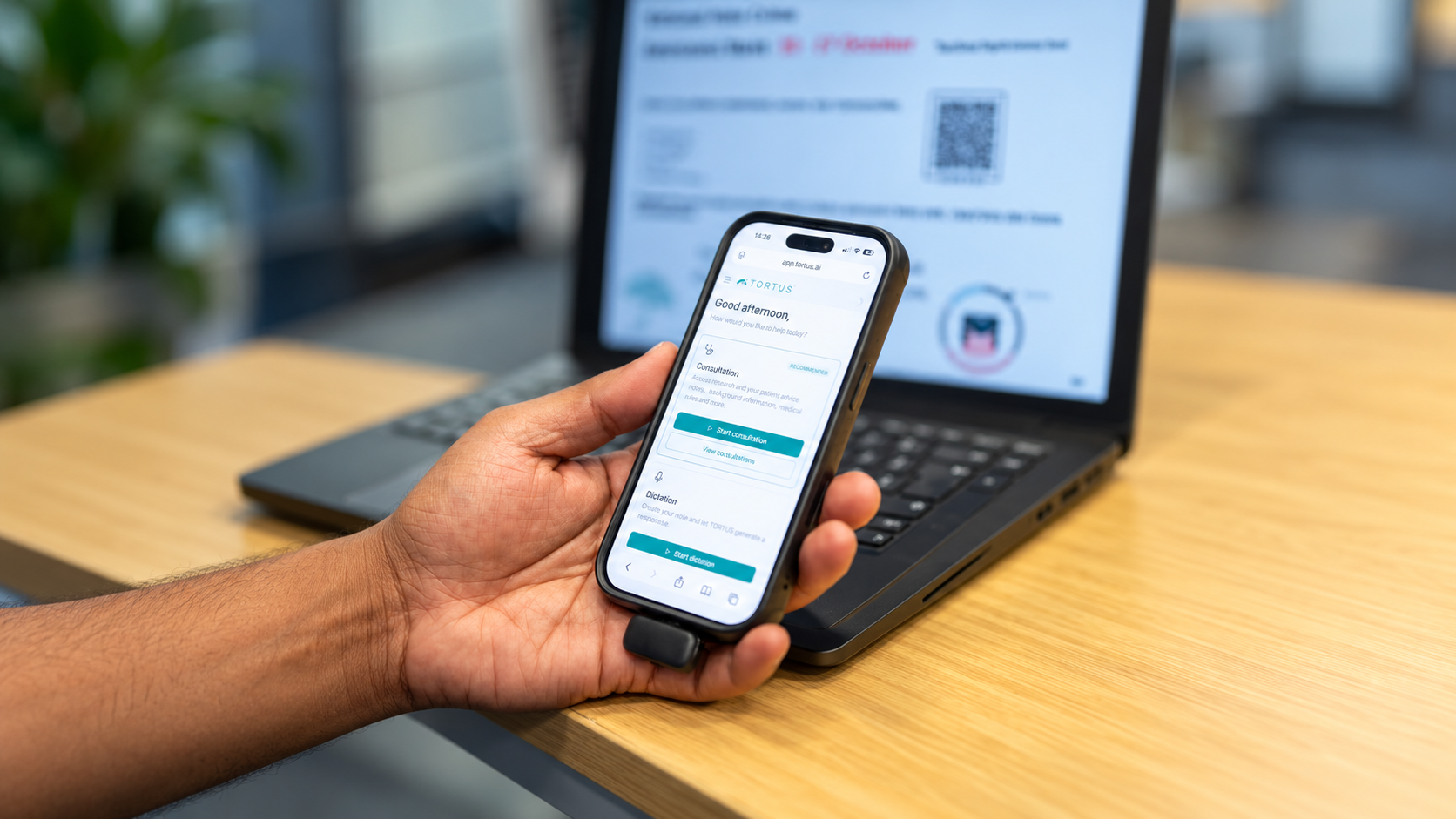
In an ambulatory bay at Leeds General Infirmary, clinicians were spending a measurable slice of every consult on the note, not the patient. After a three-month ambient voice pilot with TORTUS, the Trust reported documentation time down 61%, about 13 minutes back per consultation, with no serious safety incidents recorded. This is a Trust-reported, single-setting service evaluation. Its value is a concrete baseline for subsequent implementation, not proof that every department will achieve the same result.
What follows is the world forming around that result: who else sits in the ambient lane, what UKCA Class IIa actually changes for NHS buyers, where US and UK markets diverge, how capital should read acute minutes-saved, and what would have to be true for ambient ED to become default infrastructure rather than another pilot.
Why this matters now
Ambient documentation has crossed from novelty into budget cycles. Leeds is planning a phased ED rollout this autumn into majors, minors, paediatrics, and emergency nursing, after a February to April 2026 ambulatory pilot. TORTUS achieved UKCA Class IIa in June 2026, the first ambient voice technology to do so under that scheme according to the Trust release. For NHS buyers, that regulatory step sits alongside measured time savings as a different kind of proof than a US Series C pitch deck.
Other Trusts watching Leeds now have a public comparator. Procurement teams can ask ambient vendors for minutes-saved in named acute settings, for Approved Body device class, and for a plan that covers nursing as well as doctors. That shifts ambient from operational evaluation into operational governance.
What actually happened
Leeds Teaching Hospitals NHS Trust partnered with TORTUS to introduce ambient voice technology in the ambulatory area of the Leeds General Infirmary emergency department under Dr Sundararaj Manou, lead clinician for the Trust's adult ED. The pilot (February to April 2026) cut documentation time by 61%, saving clinicians about 13 minutes per consultation, with high accuracy on medication and allergy details and no serious safety incidents. Clinicians review and finalise notes; audio and transcriptions are temporary and auto-deleted on encrypted UK cloud servers.
Following the pilot, a phased ED introduction is planned for Autumn 2026 across majors, minors, paediatrics, and emergency nursing. Leadership named in the Trust release: Dr Dom Pimenta, CEO and co-founder of TORTUS (former NHS cardiologist); Dr Taj Hassan, Consultant in Emergency Medicine and Director of CENT-EC Global; Dr Angad Sethi (ED IT Lead); Dr Mohit Arora (lead for AVT training); Dr Bev Riley (Business Development and Innovation Manager, Innovation Pop Up). TORTUS is a member of the Trust's Innovation Pop Up and the work sits alongside Leeds membership of the NHS InSites programme.
On device status, the Trust states that in June 2026 TORTUS became the first ambient voice technology to achieve UKCA Class IIa, according to the Trust after independent assessment by a UK Approved Body. TORTUS's own certification page dates the Class IIa milestone to 24 June 2026 and names Scarlet (UK Approved Body 8536), alongside published ISO 13485, ISO 27001, Cyber Essentials Plus, DTAC, and DSPT claims. Dom Pimenta, quoted in the Trust release, said TORTUS has now seen over four million NHS patients and is evolving from vendor supply toward longer-term partnership with Trusts.