In advanced prostate oncology, the development of resistance to androgen receptor pathway inhibitors (ARPIs) such as enzalutamide, abiraterone, and apalutamide represents a virtually inevitable and lethal transition. When patients with metastatic castration-resistant prostate cancer (mCRPC) progress through first-line AR blockade, standard secondary antiandrogen monotherapy delivers dismal results: median progression-free survival collapses to roughly eight weeks (2.0 months).
This clinical dead end occurs because resistant prostate tumor clones undergo non-androgenic phenotypic switching, upregulating CD105 (endoglin) to drive rapid angiogenic escape, enrich cancer stem cell niches, and reactivate downstream TGF-beta signaling pathways. Interim Phase 2 clinical data from Kairos Pharma evaluating its first-in-class CD105 antibody ENV-105 (carotuximab) combined with apalutamide demonstrated an extraordinary median PFS of 17.7 months (p=0.0008), proving that microenvironmental vascular reprogramming can effectively reverse acquired endocrine resistance.
In This Deep Dive:
- Why this matters now: The clinical void in secondary antiandrogen resistance in mCRPC.
- What actually happened: Pivotal interim Phase 2 survival metrics (17.7 mo vs 2.0 mo, p=0.0008).
- The obvious read versus the deeper signal: Monoclonal antibodies as resistance re-sensitizers.
- Competitive taxonomy & clinical maturity: Next-generation resistant mCRPC pipelines.
- The Evidence Ladder: Endoglin biology to expanded Phase 2 multicenter trials.
- 📈 The HealthTech Investor's Signal: Unlocking value in off-patent antiandrogens and biopharma M&A.
- Counter-thesis: Sample size maturation, radiopharmaceutical competition (Pluvicto), and trial timelines.
- Forward intelligence: 4 observable test indicators for the upcoming 12 to 24 months.
- The bottom line for urologic oncologists, clinical trialists, and biotech investors.
Why this matters now
Prostate cancer remains the second leading cause of cancer-related death among men in Western nations. While next-generation androgen receptor axis inhibitors transformed overall survival over the past decade, tumors invariably acquire adaptive resistance mechanisms. Once a patient progresses on an initial AR inhibitor, switching to an alternative androgen blocker yields negligible clinical benefit, forcing clinicians toward cytotoxic taxane chemotherapy or radioligand therapies.
CD105 (endoglin) is a crucial coreceptor in the TGF-beta signaling complex, selectively expressed on actively proliferating tumor endothelial cells and cancer stem cells while largely absent on resting quiescent vasculature. When AR signaling is pharmacologically shut down, prostate tumor cells upregulate CD105 to initiate neovascularization, promote epithelial-mesenchymal transition (EMT), and protect cancer stem cells from hormonal deprivation. By selectively neutralizing CD105, ENV-105 dismantles this vascular escape hatch and resensitizes resistant tumor cells to antiandrogen inhibition, extending the duration of hormonal control by nearly nine-fold.

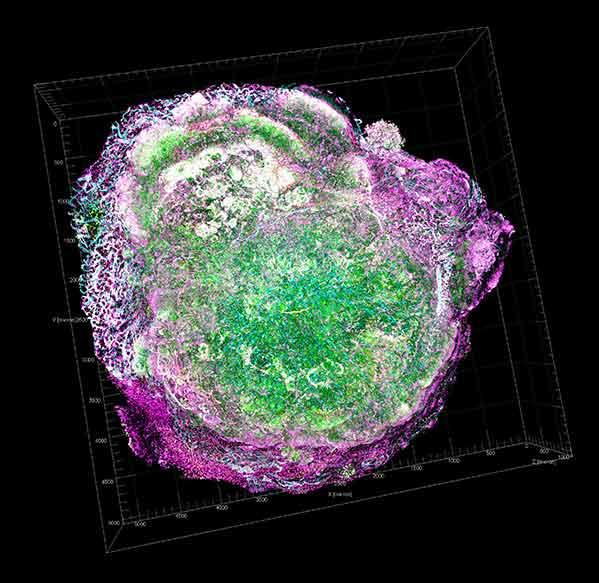
Resistant tumors build new vasculature through CD105; neutralizing it removes the escape hatch. Image: The HealthTech Signal
What actually happened
In the ongoing multicenter Phase 2 clinical trial (NCT05534646), investigators at premier cancer centers (including Cedars-Sinai Medical Center, City of Hope, and Huntsman Cancer Institute) enrolled patients with metastatic castration-resistant prostate cancer who had previously progressed on AR pathway inhibitors.
The interim statistical analysis revealed a striking divergence in disease control: patients treated with the combination of ENV-105 (carotuximab) and apalutamide achieved a median progression-free survival of 17.7 months, compared to just 2.0 months for patients receiving apalutamide monotherapy (p=0.0008). This represents an absolute progression-free survival extension of 15.7 months in a patient cohort that historically faced immediate disease progression.
The combination demonstrated a manageable safety and tolerability profile, with adverse events consistent with antiangiogenic antibody therapy and no dose-limiting overlapping toxicities with apalutamide. Based on these interim results, Kairos Pharma is expanding the study protocol to evaluate ENV-105 in combination with enzalutamide earlier in the disease sequence, targeting full Phase 2 completion in or before Q4 2027.
The obvious read versus the deeper signal
The immediate industry takeaway is that a micro-cap clinical-stage biotech has reported positive interim Phase 2 data in resistant prostate cancer. The deeper structural signal is the emergence of microenvironment-targeted antibodies as biological re-sensitizers that revitalize entire classes of off-patent and late-lifecycle oncology blockbusters.
Over the past two decades, biopharma R&D has heavily focused on designing increasingly potent single-agent targeted molecules or cytotoxic conjugates. However, cancer evolutionary biology repeatedly demonstrates that solid tumors evade monolithic pathway blockade through microenvironmental remodeling. ENV-105 proves that combining a microenvironment normalizer (anti-CD105 vascular and stem cell disruption) with a legacy targeted agent (androgen receptor blockade) can overcome complex multi-pathway resistance without compounding systemic cytotoxic toxicity.
🔒 HEALTHTECH SIGNAL PLUS · EXCLUSIVE SUBSCRIBER INTELLIGENCE