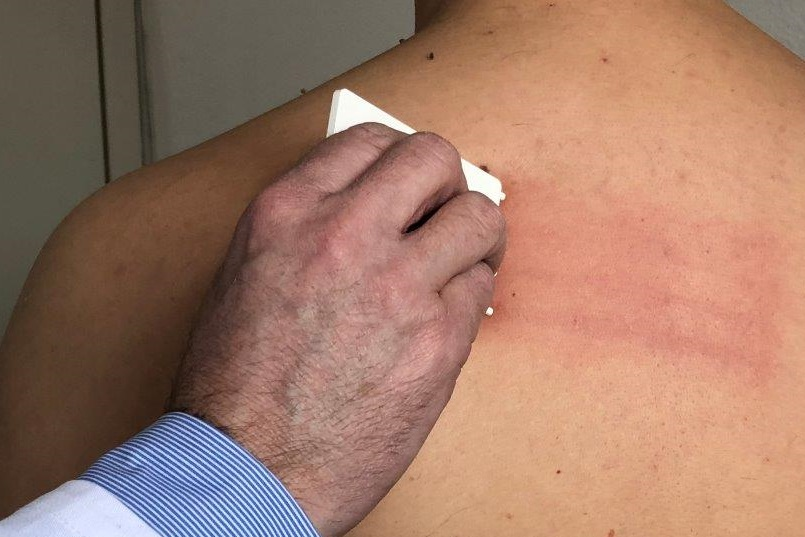
Chronic inducible urticaria (CIndU) represents one of the most frustrating frontiers in dermatologic immunology. Unlike chronic spontaneous urticaria, where hives erupt without identifiable triggers, patients with symptomatic dermographism experience intensely pruritic linear wheals from basic physical contact: friction from tight clothing, towel drying, carrying a shoulder bag, or scratching an itch.
For decades, these patients have been trapped in an off-label therapeutic cycle. Standard second-generation H1 antihistamines fail in over 60% of cases even when up-dosed to four times the FDA-approved label, while injectable anti-IgE biologics produce inconsistent relief because mechanical shear triggers mast cell degranulation through rapid non-classical biophysical pathways. Yesterday's FDA approval of Novartis's Rhapsido (remibrutinib) establishes the first targeted, FDA-authorized therapy for symptomatic dermographism, validating oral Bruton's tyrosine kinase (BTK) inhibition as a rapid-onset master switch for mast cell activation.
In This Deep Dive:
- Why this matters now: The neglected burden and mechanism of chronic inducible urticarias.
- What actually happened: Pivotal Phase 3 RemIND trial data, Total Fric Score endpoints, and fast onset.
- The obvious read versus the deeper signal: Oral small molecules disrupting injectable biologic monopolies.
- Competitive taxonomy & clinical maturity: Next-generation urticaria and mast cell pipelines.
- The Evidence Ladder: Kinase selectivity to first-in-disease FDA approval.
- 📈 The HealthTech Investor's Signal: Commercial immunology TAM expansion, pricing power, and franchise leverage.
- Counter-thesis: Antihistamine step-therapy mandates, biologic competition, and real-world compliance.
- Forward intelligence: 4 observable test indicators for the upcoming 12 to 24 months.
- The bottom line for dermatologists, allergists, and life sciences venture allocators.
Why this matters now
Symptomatic dermographism affects approximately 2% to 5% of the general population, representing the single most prevalent subtype of chronic inducible urticaria. For millions of affected individuals, ordinary mechanical stimulation of the skin results in immediate histamine, leukotriene, and cytokine release from dermal mast cells, producing painful, disfiguring wheals and relentless pruritus that severely degrades quality of life.
Until now, no therapeutic of any kind held formal FDA approval for this condition. While omalizumab (Xolair) revolutionized chronic spontaneous urticaria, its efficacy in inducible physical urticarias is variable and requires monthly clinic visits for subcutaneous biologic injections. By contrast, remibrutinib is a highly potent, covalent oral BTK inhibitor dosed at 25 mg twice daily that directly inhibits the intracellular signaling cascade downstream of the high-affinity IgE receptor (FcεRI) and associated mechanical stress sensors, halting mast cell and basophil degranulation at the molecular root.

Mast cell degranulation is the molecular event remibrutinib blocks inside the cell. Image: The HealthTech Signal
What actually happened
In the pivotal, randomized, double-blind, placebo-controlled Phase 3 RemIND trial (n=115, NCT05976243), adults with moderate-to-severe symptomatic dermographism refractory to standard H1 antihistamines were randomized to receive oral remibrutinib 25 mg twice daily or placebo for 12 weeks.
The trial met its primary efficacy endpoint with high statistical significance: at Week 12, 29.35% of patients receiving remibrutinib achieved a complete response in hive formation (Total Fric Score = 0) following standardized mechanical friction provocation (using a validated Dermographic Tester / FricTest device), compared to just 14.0% of patients on placebo (p=0.0229). Clinically meaningful symptom reduction was documented as early as Week 2 of treatment.
The safety and tolerability profile was remarkably clean, with no liver toxicity signals, severe bleeding events, or cardiovascular adverse effects that historically shadowed earlier non-selective BTK inhibitors. Discontinuation rates due to adverse events were comparable between remibrutinib and placebo arms, confirming a favorable benefit-risk profile for continuous outpatient administration.
The obvious read versus the deeper signal
The surface takeaway across pharmaceutical industry commentary is that Novartis has added a modest niche label expansion to remibrutinib alongside its prior chronic spontaneous urticaria approval. The deeper structural signal is the successful expansion of oral small-molecule kinase inhibitors into autoimmune and inflammatory spaces historically dominated by multi-thousand-dollar injectable biologics.
Biologics targeting extracellular cytokines or circulating IgE antibodies operate outside the cell membrane, requiring massive systemic circulating concentrations to neutralize ligands. In contrast, intracellular covalent kinase inhibitors like remibrutinib access the cytosolic catalytic machinery of mast cells and B cells, silencing the degranulation trigger within minutes of oral absorption. This approval demonstrates that precision kinase design can achieve exquisite target selectivity without off-target toxicities, positioning oral small molecules to capture substantial market share from injectable monoclonal antibodies across dermatology and allergy.
🔒 HEALTHTECH SIGNAL PLUS · EXCLUSIVE SUBSCRIBER INTELLIGENCE