In hematologic oncology, few treatment regimens have maintained such an unyielding stranglehold on standard of care as R-CHOP (rituximab, cyclophosphamide, doxorubicin, vincristine, and prednisone). Established in the late 1990s as the definitive frontline therapy for diffuse large B-cell lymphoma (DLBCL), R-CHOP cures roughly 60% of patients. However, for the remaining 40% who harbor intermediate to high-risk disease, frontline treatment failure initiates a cascade of aggressive relapses, intensive salvage chemotherapy, and grueling autologous cellular therapies.
For a quarter of a century, dozens of prospective Phase 3 clinical trials attempting to improve upon R-CHOP by adding proteasome inhibitors, immunomodulatory agents, or BTK inhibitors met with failure or prohibitive toxicities. Genmab and AbbVie's announcement yesterday of positive topline data from the Phase 3 EPCORE DLBCL-2 trial represents the historic clinical breach of that 25-year plateau.
In This Deep Dive:
- Why this matters now: The clinical stagnation of frontline large B-cell lymphoma.
- What actually happened: Pivotal Phase 3 EPCORE DLBCL-2 hazard ratios and survival curves.
- The obvious read versus the deeper signal: Bispecific antibodies vs autologous CAR-T economics.
- Competitive taxonomy & clinical maturity: Next-generation frontline DLBCL regimens.
- The Evidence Ladder: Subcutaneous CD3xCD20 engagement to global regulatory submissions.
- 📈 The HealthTech Investor's Signal: Outpatient community oncology economics and franchise revenue shifts.
- Counter-thesis: Cytokine release syndrome management in community clinics and Pola-R-CHP competition.
- Forward intelligence: 4 observable test indicators for the upcoming 12 to 24 months.
- The bottom line for hematologic oncologists and life sciences investors.
Why this matters now
Diffuse large B-cell lymphoma is the most common form of non-Hodgkin lymphoma worldwide, accounting for over 30,000 newly diagnosed cases annually in the United States alone. While patients with low International Prognostic Index (IPI) scores achieve excellent long-term remissions with standard chemoimmunotherapy, high-risk patients (IPI 2 to 5) face relapse rates exceeding 45% within two years.
Although autologous CAR-T cell therapies revolutionized second- and third-line DLBCL, their commercial reach has been severely bottlenecked by complex viral vector biomanufacturing, vein-to-vein turnaround times of 3 to 5 weeks, and massive inpatient hospitalization costs exceeding $500,000 per patient. Demonstrating a 51% reduction in disease progression or death in the frontline setting using an off-the-shelf, subcutaneous fixed-duration bispecific antibody shifts the entire therapeutic paradigm from reactive cell salvage to upfront outpatient curative intent.
What actually happened
In the pivotal, randomized, open-label Phase 3 EPCORE DLBCL-2 trial, newly diagnosed adult patients with CD20-positive DLBCL and IPI scores of 2 to 5 were randomized to receive fixed-duration subcutaneous epcoritamab (DuoBody-CD3xCD20) in combination with standard R-CHOP versus R-CHOP chemoimmunotherapy alone.
Epcoritamab plus R-CHOP met its primary endpoint with extreme statistical robustness, delivering a 51% reduction in the risk of progression-free survival (PFS) events or death compared to standard chemoimmunotherapy (hazard ratio [HR] = 0.49, 95% CI: 0.36 to 0.67, p<0.0001) across the broad intent-to-treat population.
Safety and tolerability aligned with previous combination cohorts: low-grade cytokine release syndrome (CRS) was effectively managed with step-up dosing and prophylactic dexamethasone, with negligible rates of high-grade immune effector cell-associated neurotoxicity syndrome (ICANS). Crucially, the fixed-duration subcutaneous design allowed patients to complete immunotherapy without requiring permanent indefinite dosing.
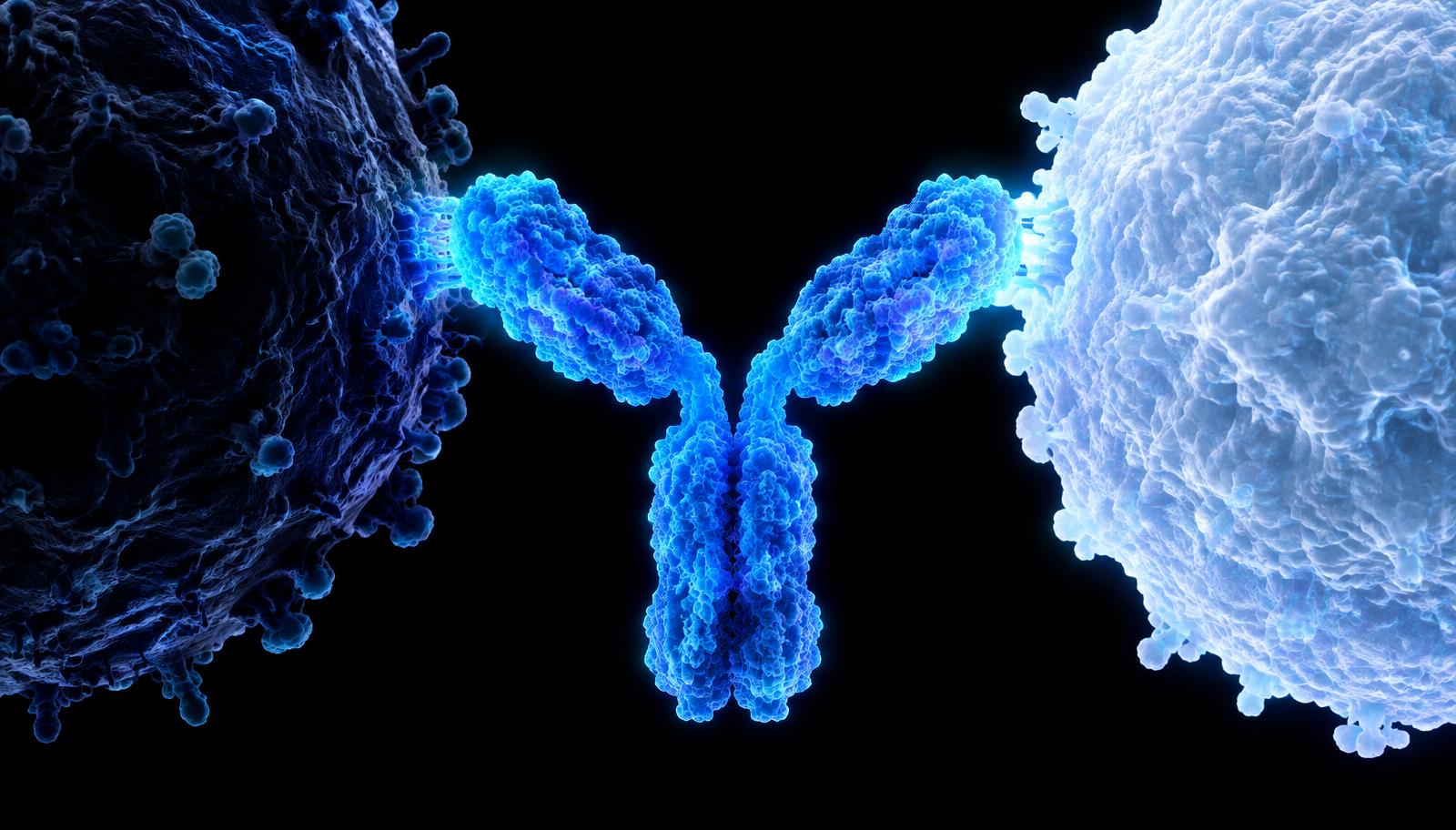
A bispecific antibody transiently tethering a cytotoxic T cell to a malignant B cell. Image: The HealthTech Signal
The obvious read versus the deeper signal
The standard industry takeaway is that Genmab and AbbVie have won a major oncology label expansion to compete with Roche's Polivy (polatuzumab vedotin + R-CHP). The deeper structural signal is the definitive displacement of autologous cell therapies to secondary salvage status and the migration of T-cell immunotherapy into community outpatient clinics.
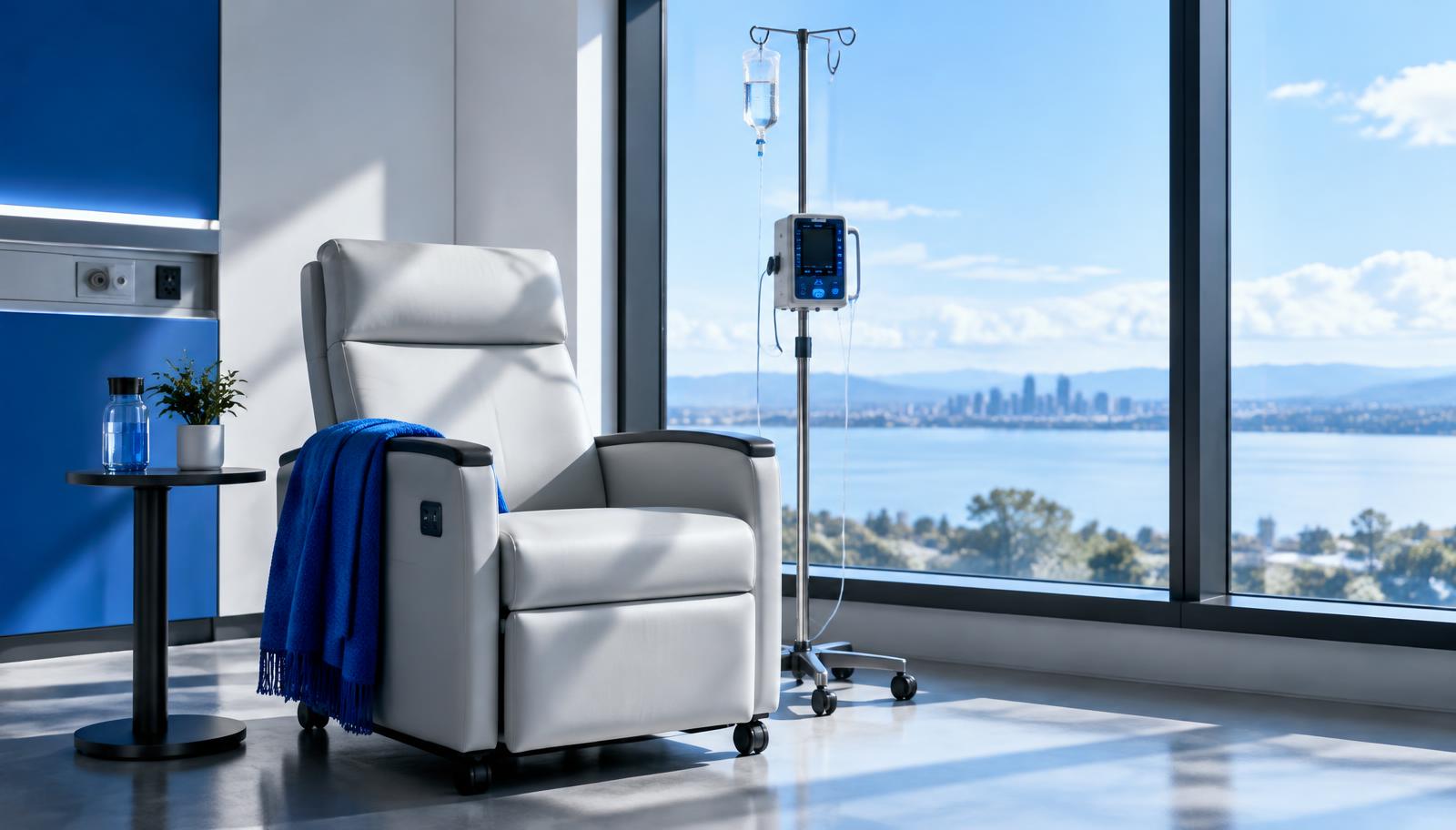
Autologous CAR-T therapies (such as Yescarta and Breyanzi) established clinical dominance based on potent T-cell redirection. However, epcoritamab's DuoBody architecture achieves comparable direct T-cell mediated lymphoma lysis by transiently tethering CD3 on cytotoxic T cells to CD20 on malignant B cells, delivered as a convenient, off-the-shelf subcutaneous injection. By bringing fixed-duration T-cell engagement directly into frontline community oncology infusion chairs, Genmab and AbbVie eliminate the manufacturing wait times, leukapheresis procedures, and academic medical center bottlenecks that have constrained cellular therapy adoption.
🔒 HEALTHTECH SIGNAL PLUS · EXCLUSIVE SUBSCRIBER INTELLIGENCE