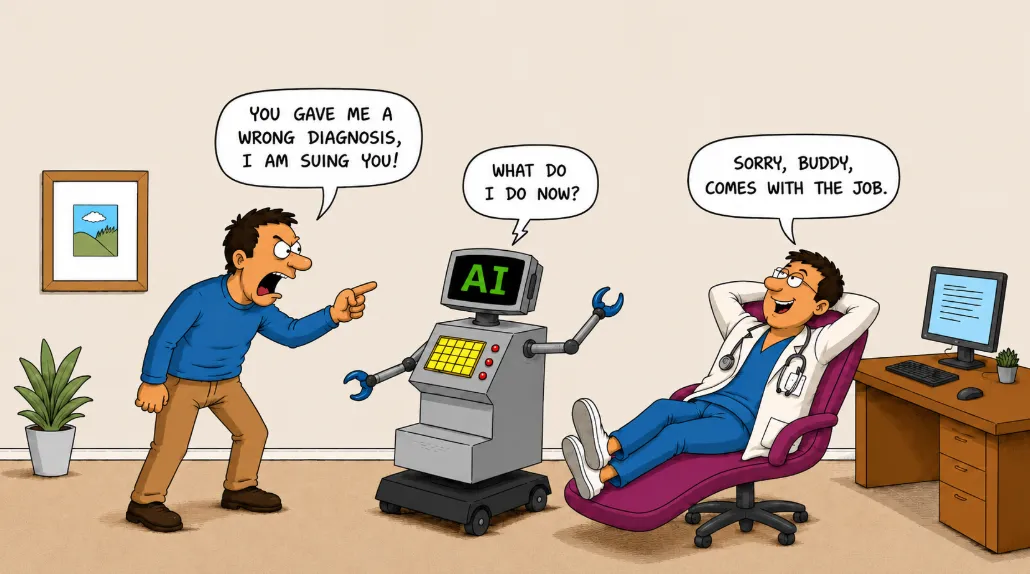
At 5:15 PM on a Friday in February 2026, Dr. Marcus Chen, an internist practicing at a large outpatient clinic in Oregon, sat before his electronic health record monitor. He had 42 patient charts awaiting signature. Every one of those charts had been compiled using an ambient AI documentation assistant, a tool his health system deployed six months prior to combat clinician burnout. On average, Dr. Chen spent 45 seconds reviewing each note before clicking sign off. In note 28, representing an annual physical for a 54 year old patient, the ambient AI recorded that the patient denied chest tightness, when the patient had actually reported intermittent mild chest tightness on exertion but denied acute chest pain at rest. Dr. Chen missed the omission during his rapid review and signed the note. Three weeks later, the patient suffered an acute myocardial infarction during a morning run.
When the subsequent malpractice claim was initiated, the legal realities of the modern healthtech stack became clear. The patient's attorney pointed to the medical record as evidence of a missed diagnostic signal. The health system's legal team pointed to the software's user agreement, which placed all verification responsibility on the signing physician. The AI software vendor pointed to their terms of service, which clearly stated the product was an administrative aid and not a licensed medical practitioner. Dr. Chen was left holding the clinical and legal liability for an algorithm's omission.
This scenario is not hypothetical. It represents the defining operational challenge of the current era: the clinical accountability gap, which is defined as the legal, operational, and ethical void where the deployment speed of medical artificial intelligence exceeds the clarity of liability assignment among clinicians, healthcare institutions, and technology providers.
The Erosion of the Learned Intermediary Standard
For decades, the legal framework governing medical devices and software relied heavily on the learned intermediary doctrine. This is defined as a legal principle holding that a medical manufacturer fulfills its duty to warn by informing the prescribing clinician, who then acts as the expert intermediary between the product and the patient. Under this framework, if a doctor uses a diagnostic tool or prescribes a drug, the doctor is expected to exercise independent professional judgment to catch any errors. The manufacturer is generally shielded from direct malpractice liability unless the tool itself was physically defective or failed to perform as advertised.
In 2026, this doctrine is under unprecedented strain. The sheer volume and velocity of clinical data processed by generative AI tools make true independent verification nearly impossible for a busy clinician. When an AI summarizes a 400 page historical medical record in three paragraphs, a doctor cannot realistically re-read all 400 pages to verify the summary during a 15 minute consultation.
This creates a psychological phenomenon known as automation bias, which is defined as the human tendency to trust automated systems blindly and ignore contradictory information or fail to search for omissions. When clinicians become accustomed to AI outputs being correct 99 percent of the time, their vigilance drops. Courts are beginning to grapple with whether it is legally reasonable to expect a human clinician to catch subtle, infrequent errors in massive datasets generated by machine learning models.
The Contractual Reality of Hold Harmless Clauses
For healthtech founders and operators, the business-to-business reality of this gap is defined by contract negotiations. Historically, enterprise software vendors have utilized standard indemnification and hold harmless clauses to insulate themselves from any clinical outcomes. A typical software agreement in 2026 still states that the software is provided on an as-is basis, that it does not constitute the practice of medicine, and that the health system agrees to indemnify the vendor against any third-party claims arising from the use of the technology.
However, the bargaining power is shifting. Large integrated delivery networks are increasingly refusing to sign contracts with absolute hold harmless language. Risk management departments at major academic medical centers are demanding that vendors provide some level of indemnification, particularly if the AI tool is marketed as an autonomous or semi-autonomous diagnostic aid.
Some forward-thinking vendors are adapting by offering tiered liability structures. In these arrangements, the vendor assumes financial liability up to a specified cap if the error can be mathematically proven to have originated from a code regression or a failure of the model to adhere to documented performance standards. This shift requires healthtech startups to secure robust technology errors and omissions insurance policies that specifically cover clinical decision support failures, a market that is rapidly hardening in 2026.
Designing for Safety and Verification
To survive this regulatory and legal landscape, healthtech builders must move away from designing for frictionless user experiences and instead design for defensible verification. If a tool is too seamless, it encourages the very automation bias that leads to malpractice claims.
First, product teams must introduce intentional friction into clinical workflows. For example, instead of a single approve button at the bottom of an AI-generated note, the user interface should require the clinician to verify specific high-risk sections. This can be achieved by highlighting key clinical facts, such as drug dosages, allergies, and critical negative findings, and requiring a physical tap or hover to confirm review of those specific elements before the note can be finalized.
Second, vendors must build comprehensive audit trails. An audit trail should not merely record that a clinician signed a note. It should log exactly how long the clinician viewed the AI-generated content, which edits they made, and which source documents the AI used to generate its recommendations. If a clinician edits a draft note, the system must preserve both the raw AI output and the final human-edited version. This level of telemetry is crucial for defense attorneys attempting to prove that a physician exercised independent clinical judgment rather than passively accepting an automated output.
Third, healthtech operators must establish clear clinical governance committees within client health systems. These committees, consisting of chief medical information officers, risk managers, and practicing clinicians, should establish clear guidelines on what tasks AI is permitted to perform autonomously, which tasks require real-time human verification, and which tasks must remain entirely manual.
Key Signals
Health systems must transition from passive software procurement to active risk-sharing agreements that require AI vendors to assume some clinical liability.
Product designers need to introduce deliberate friction into clinical workflows to combat automation bias and ensure physicians actually review AI-generated notes.
Professional liability insurers will soon mandate specialized riders for practices utilizing generative AI, shifting premiums based on the auditability of the technology.