Good morning, HealthTech insiders. Tempus AI just got its third FDA-cleared AI cardiovascular device, and this one is doing something the cardiologist in me finds genuinely interesting: it detects signs of pulmonary hypertension from a routine ECG. No invasive right heart catheterization. No specialist referral as the first step. The test that every primary care doctor already orders. That is a real workflow shift.

Meanwhile, a study published today in medRxiv catalogued 107 large language models working through real-world clinical tasks and found that 84% of model-task pairs produced stigmatizing language, and that reasoning models performed worse than simpler ones. Two clearances and one study, and together they describe where clinical AI actually stands right now: earning regulatory stamps faster than health systems can audit what those tools are quietly doing inside patient records.

CLINICAL AI

In today's Signal:

  • Tempus AI gets FDA 510(k) clearance for ECG-based pulmonary hypertension detection, its third cardiovascular AI device cleared this year.

  • A medRxiv study of 107 LLMs finds 84% produce stigmatizing clinical language, and reasoning models are worse than standard ones.

  • Cityblock acquires Homeward Health and closes a $116M Series E to build an urban-to-rural government-funded care platform targeting 120M Americans.

  • Berry Street and Healthify merge to form the largest insurance-covered AI metabolic health platform in the U.S.

  • Follow the money: Experity acquires Exdion; RCM automation consolidates as billing AI gets absorbed by platform operators.

LATEST DEVELOPMENTS

DIAGNOSTICS
1. Tempus AI can now flag pulmonary hypertension from the ECG your GP already ordered.

Source: BusinessWire / Tempus AI press release, August 24, 2026

Source: Google Research / Google DeepMind multimodal AMIE study

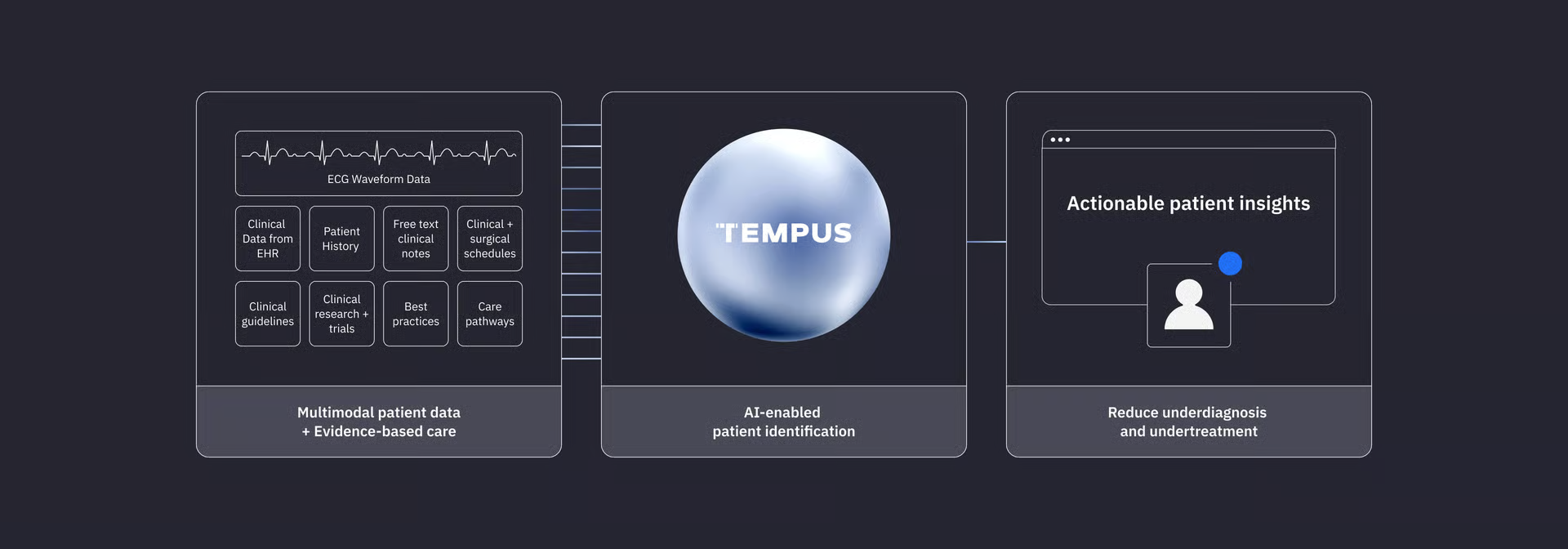
The signal: Tempus AI (NASDAQ: TEM) received FDA 510(k) clearance for Tempus ECG-PH, software that analyzes a standard 12-lead ECG for signs of elevated pulmonary artery pressure, an indicator of pulmonary hypertension (PH). It is Tempus' third FDA-cleared cardiovascular AI device, following previous clearances for atrial fibrillation and low ejection fraction detection.

The details:

  • PH affects roughly 1% of the population and up to 10% of adults over 65. Diagnosis has historically required right heart catheterization (an invasive procedure entering through the right side of the heart) plus echocardiography.

  • Tempus ECG-PH analyzes resting 12-lead ECG recordings from patients 40 and older with cardiac symptoms (breathlessness, fatigue, chest pain, or swelling) who have no known PH history. It outputs a binary risk flag for elevated mean pulmonary artery pressure above 20 mmHg.

  • Brandon Fornwalt, MD PhD, Tempus' SVP of Cardiology, said the tool is designed to surface PH risk at the point of routine testing, before the specialist referral pathway begins. assesses diagnostic accuracy, clinical history taking, and communication empathy across complex simulated video patient visits.

Why it matters: Pulmonary hypertension kills slowly because no one catches it early: the symptoms are vague, the gold-standard test is invasive, and most patients see a primary care doctor long before they see a cardiologist. A binary flag on a routine ECG changes when the question gets asked. Tempus is building a cardiovascular AI portfolio with real diagnostic leverage at the earliest point of contact.

CLINICAL AI
2. Reasoning AI models are generating more clinical bias, not less.

Source: Fierce Healthcare / Getty Images (AI and precision medicine concept image)

Source: Duke-Margolis Institute for Health Policy / FDA Workshop

The signal: A preprint study published August 25 in medRxiv evaluated 107 LLMs across 35 real-world clinical tasks, scanning 3,745 model-task pairs for stigmatizing language in the models' clinical reasoning. Lead team includes Harvard/MIT-affiliated researchers Leo Anthony Celi and David Bates.

The details:

  • 84.06% of model-task pairs produced stigmatizing terms. Stigma rates ranged from 0% to 33.33% across models.

  • Reasoning models (designed for deeper chain-of-thought) generated more stigmatizing language than standard models: 2.35% vs. 1.70% average stigma rate. Medical-specific models performed no better than general-purpose ones.

  • 19.76% of pairs actively amplified bias already present in the original patient notes. A correlation of -0.304 between stigma rate and task accuracy shows this bias directly degrades clinical reasoning quality. Targeted prompt engineering cut stigma rates by up to 91.91% without degrading performance.

Why it matters: Every health system deploying LLMs for clinical documentation is sitting on a documented bias amplification risk. The finding that reasoning models perform worse is counterintuitive and directly relevant, because those are exactly the models being positioned as the next upgrade in clinical AI. Guardrails work. Health systems need to require them before contract sign-off, not after an incident review.

PROVIDERS
3. Cityblock just bought rural care expertise it did not have, and $116M to deploy it.

Source: Fierce Healthcare / Homeward Health (Homeward mobile clinic press photo, 2026)

Source: Rock Health Digital Health Venture Investment Report

The signal: Cityblock Health signed a definitive agreement to acquire Homeward Health in an all-stock deal, pairing Cityblock's urban Medicaid AI platform with Homeward's rural Medicare Advantage expertise. Cityblock simultaneously closed a $116M Series E led by General Catalyst, bringing total raised to approximately $1 billion. The combined company targets 120 million Americans on government-funded insurance.

The details:

  • Cityblock, founded in 2017 out of Alphabet's Sidewalk Labs and led by CEO Toyin Ajayi, serves nearly 200,000 urban Medicaid and dual-eligible members across 10+ states. Annual revenue is $2.2 billion, up 77% year over year.

  • Homeward Health, founded in 2022 by Dr. Jennifer Schneider (former CMO and president of Livongo, the digital chronic care company) and Amar Kendale, has served 50,000 rural patients across 50 counties. It uses mobile care units, remote monitoring, and an AI-native platform built for rural Medicare Advantage.

  • The deal arrives as Medicaid faces spending cuts under the One Big Beautiful Bill Act and Medicare Advantage reimbursement tightens. CEO Ajayi's framing was direct: the answer to funding pressure is not to retreat, it is to get radically more efficient at delivering outcomes for government-funded populations.

Why it matters: Urban value-based care companies have historically avoided rural markets, where unit economics are harder and populations more complex. Cityblock just decided the complexity is the point. If Homeward's rural AI model and Cityblock's outcomes data can be combined into a single platform, this is one of the most serious bets yet that government-funded care can actually bend the cost curve.

QUICK HITS

💰 FOLLOW THE MONEY

  • The deals: Cityblock Health acquires Homeward Health (all-stock), closes $116M Series E led by General Catalyst. Berry Street and Healthify complete all-stock merger, led by co-CEOs Noah Kotlove and Tushar Vashisht, forming the largest insurance-covered AI metabolic health platform in the U.S. (terms undisclosed). Experity acquires Exdion Healthcare (terms undisclosed) for AI-driven chart-to-cash coding and billing automation across urgent care.

  • The pattern: The capital is building delivery infrastructure for populations that have historically been underserved or too hard to reach: rural Medicare, government-funded dual-eligibles, and the GLP-1 clinical support layer. Simultaneously, RCM automation consolidation is quietly accelerating as platform operators absorb billing AI rather than leaving it as a standalone point tool.

🩺 THE CLINICIAN’S SIGNAL

  • On the Tempus ECG-PH clearance: PH is a late diagnosis because the referral pathway is long and early symptoms overlap with a dozen other conditions. A binary flag on the ECG I already ordered gives me a reason to accelerate that referral without waiting for the echo. I would want the sensitivity and specificity data before trusting this in practice, but the concept solves a real workflow bottleneck.

  • On the LLM bias study: if I am using an AI tool for clinical documentation or note summarization, I now have peer-reviewed evidence that the model may be amplifying language in my notes that I would not sign off on if I read it carefully. That is a liability I did not consent to when I clicked 'enable AI.' Health systems owe clinicians transparency about which guardrails are active on the models deployed in their name.

  • On the Cityblock-Homeward deal: the hardest part of rural primary care is continuity. Rural patients often see a different face every visit because clinician turnover is brutal. Homeward's model of embedded local providers with remote monitoring support is one of the few approaches that actually addresses that. Whether Cityblock's Medicaid-built platform translates to rural Medicare is the open question.

🛠️ Trending HealthTech AI Tools & Startups

  • Tempus ECG-PH: FDA 510(k)-cleared AI software detecting pulmonary hypertension signs from standard 12-lead ECGs. Third cardiovascular AI clearance for Tempus this year after AF and low ejection fraction detection tools.

  • Healthify Ria: Multimodal, multilingual AI nutrition coach with patented one-second food-logging via photo. Now integrated into Berry Street's U.S. insurance-covered clinical network serving 200,000+ patients and 45M global users.

  • Cityblock CORE (Care Orchestration and Resourcing Engine): AI platform pulling fragmented member data for predictive outreach. Correct-prediction rate of 62%-87%; now being extended to rural Medicare Advantage populations post-Homeward acquisition.

  • Exdion AI RCM: Autonomous chart-to-cash coding, billing, and compliance AI platform (acquired by Experity). Processes the vast majority of patient visits without manual intervention across nearly half of all U.S. urgent care centers.

  • Berry Street: Co-led by Noah Kotlove and Tushar Vashisht as co-CEOs post-merger with Healthify; now the largest insurance-covered AI metabolic health platform in the U.S., with 2,000+ clinicians, 45M global users, and a CMS ACCESS model contract for chronic condition management.

  • Homeward Health: Founded by Dr. Jennifer Schneider and Amar Kendale; built a rural-first Medicare Advantage care model across 50 counties and 50,000 patients using mobile clinics and AI-native tools. Being acquired by Cityblock Health.

  • Flagler Health: Led by Albert Katz, CEO; raised $50M Series B (Bessemer Venture Partners) for its AI-native musculoskeletal care platform, generating $164,000 average additional annual revenue per provider in 36 states.

  • Cadence: Founded by Chris Altchek; raised $100M Series C (Spark Capital) for AI-powered chronic care management of older adults at 20+ health systems. AI agents monitor vitals daily and support medication adjustments.

📣 Highlights: Events, Lists & Deep Dives

That's it for today!

Before you go, was today’s Signal worth your time? Let us know. Your feedback helps us keep improving what we send you.

How did we do today?

See you tomorrow,

Dr. Dereck Mush, MD, MBA

The HealthTech Signal is independently funded. Sponsorships help us invest in better reporting, research, and a stronger newsletter for our readers. Want to reach HealthTech founders & executives while supporting the Signal? Get in touch.

Was this email forwarded to you? Sign up here.

Until tomorrow,
The HealthTech Signal