Inside Phantom Neuro's First Human Implants: Sensing Muscle Beneath the Skin

Dr. Dereck Mush, MD, MBAThe Daily SignalOctober 22, 2026
PLUS: XRlabs Closes $8.4M Seed Led by Playground Global to Deploy NVIDIA Jetson Thor Physical AI in Operating Rooms

Good morning, HealthTech insiders. A cosmetic outpatient procedure in suburban Melbourne and a graphics processing cluster inside an operating room exoscope do not look like parts of the same technological transition on the surface. Yet both reflect healthcare technology shifting away from monolithic capital equipment toward low-friction, modular intelligence layers. When the adoption barrier for neural interfaces drops from open neurosurgery to a 60-minute local anesthetic insertion, and the barrier for surgical AI drops from a multi-million-dollar robotic console to edge compute running on existing displays, clinical deployment mechanics fundamentally change.
This morning we are tracking three developments that illustrate this exact transition across hardware, procedural medicine, and health system operations. In clinical neurotechnology, Phantom Neuro has achieved first-in-human sub-dermal implantation under the FDA-CMS RAPID pathway. In surgical intelligence, XRlabs secured $8.4 million to embed sub-10ms spatial perception directly into operating room monitors via NVIDIA Jetson Thor. And in enterprise hospital workflows, Invoca deployed autonomous voice and messaging agents integrated bi-directionally across five major EHRs to tackle the 46% of inbound patient appointment calls that currently go unanswered.
In today's Signal:
First-in-human sub-dermal neurotech: Phantom Neuro implants its Phantom X wireless sensor in outpatient CYBORG study participants, bypassing craniotomy risks to decode phantom limb motor intent.
Modular surgical physical AI: XRlabs lands $8.4M seed backing led by Playground Global to deploy NVIDIA Jetson Thor edge perception across legacy hospital exoscopes and displays.
Autonomous front-door EHR intake: Invoca launches multi-EHR bi-directional agents across Epic, athenahealth, and eClinicalWorks to automate clinical scheduling and stop patient leakage.
Follow the Money & Investor Signal: Capital concentrates in low-friction clinical enablement layers with accelerated Category III coding and CMS reimbursement runways.
Most GTM problems aren’t one big failure. They’re one or two weak spots quietly dragging down the rest.
The free GTM Audit scores your go-to-market across four dimensions, then sequences a 90-day roadmap for your stage.
Drop your URL. Get your score in about 10 minutes.
LATEST DEVELOPMENTS

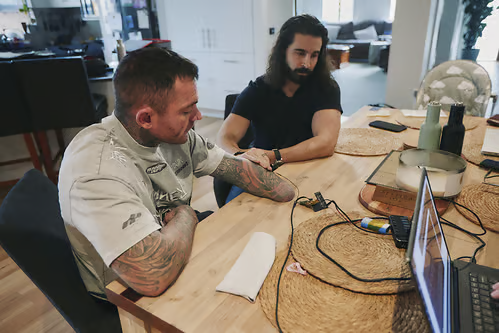
Phantom Neuro CEO Dr Connor Glass reviews the Phantom X system with Michael Easy, the first participant in the company’s CYBORG clinical trial.
Credit: Phantom Neuro, via PR Newswire.
Austin-based neurotechnology pioneer Phantom Neuro has completed the first human implantations of its Phantom X sub-dermal neural interface as part of the CYBORG early feasibility study at Cabrini Health in Melbourne, Australia.
The details:
The Phantom X sensor was implanted in outpatient procedures lasting approximately one hour without general anesthesia, positioning the platform as a low-risk, cosmetic-style alternative to invasive craniotomies.
The system sits beneath the skin directly over residual limb musculature, capturing intact neuromuscular electrical intent and translating phantom limb motor signals into low-latency wireless commands for robotic prostheses and computing interfaces.
Founded by physician Dr. Connor Glass (MD), Phantom Neuro is backed by Ottobock ($19M Series A), DARPA, and has secured FDA Breakthrough Device designation alongside enrollment in the FDA and CMS RAPID joint reimbursement acceleration pathway.
The Signal: By bypassing intracortical brain arrays in favor of high-fidelity sub-dermal peripheral neuromuscular sensing, Phantom Neuro circumvents the neurosurgical risks, glial scarring, and ICU overhead that bottleneck brain-computer interfaces. If outpatient 60-minute implantation replicates laboratory motor precision, the total addressable market expands from severe quadriplegia to millions of amputees and physical robotics operators.

A surgeon works with XRlabs’ digital twin technology in an operating theatre.
Credit: XRlabs.
Surgical intelligence startup XRlabs has raised $8.4 million in seed funding led by Playground Global and Eka Ventures to scale its device-agnostic operating room AI platform across global hospital networks.
The details:
Founded by practicing neurosurgeon Dr. Ali Haddad, XRlabs integrates modular computer vision directly across existing surgical displays, exoscopes (including Olympus ORBEYE), and microscopes without forcing health systems to replace legacy capital hardware.
Powered by NVIDIA Jetson Thor and NVIDIA Isaac for Healthcare, the platform delivers sub-10 millisecond surgical perception, real-time tool tracking, critical anatomical boundary contouring, and intent-aware workflow automation at the point of care.
The technology has been validated in over 100 clinical cases across three continents, including landmark first-in-human physical AI cranial neurosurgeries and AI-guided separation of craniopagus twins.
The Signal: The battle for operating room digitization is pivoting away from multi-million-dollar monolithic robotic consoles toward hardware-agnostic edge compute layers. By streaming real-time spatial awareness and anatomical guardrails onto existing OR monitors at low latency, XRlabs lowers the adoption barrier for surgical intelligence from capital budget line items to software-enabled clinical augmentation.

Conversational intelligence platform Invoca has launched a specialized Autonomous Healthcare AI Suite that connects directly into Epic, athenahealth, eClinicalWorks, NextGen Office, and ModMed to manage patient scheduling and intake without human intervention.
The details:
The solution targets the estimated 46% of inbound patient calls to US health systems that go unanswered or are abandoned, deploying conversational voice and text agents that handle multi-provider scheduling, appointment triage, and cancellations in real time.
Unlike basic Interactive Voice Response (IVR) phone trees, the platform reads real-time provider template availability, clinical rules, and payer insurance compatibility directly from EHR APIs, writing booked encounters back into provider schedules instantly.
Early health system implementations demonstrate significant reductions in scheduling staff call volume, faster time-to-appointment, and measurable recapture of lost patient referral revenue.
The Signal: Health systems are experiencing unsustainable call center labor costs and front-door patient churn. Deep, bi-directional EHR integration transforms conversational AI from a superficial marketing chatbot into an operational revenue cycle engine, unlocking direct labor arbitrage and plugging patient leakage across outpatient networks.
QUICK HITS
CYBORG study motor latency metrics and US IDE trial clearance for Phantom Neuro, alongside initial reimbursement benchmark setting under the joint FDA-CMS RAPID pathway.
Health system adoption velocity of edge AI modules versus integrated robotic towers, particularly as NVIDIA Jetson Thor silicon expands across OEM endoscopic and surgical video displays.
Payer and health system audit protocols for autonomous EHR scheduling agents, focusing on scheduling error rates, slot utilization density, and physician calendar governance.
The deals:
XRlabs: Layers AI onto existing surgical hardware, using NVIDIA edge computing to work with operating-room displays.
Phantom Neuro: Uses minimally invasive sensors placed beneath the skin, avoiding the need for brain surgery.
Invoca: Connects scheduling automation with EHR systems, supporting two-way information exchange.
The pattern: The common thread is easier deployment. These platforms build on existing equipment, use less invasive procedures or connect with established hospital software. Their appeal centres on reducing the cost and disruption of introducing new technology into clinical care.
HLTH 2026 (November 1-4, 2026 | Las Vegas, Nevada): The premier gathering for healthtech innovation, payer-provider transformation, and clinical AI commercialization, setting executive agendas for 2027.
Frontiers Health 2026 (October 20-21, 2026 | Berlin, Germany & Hybrid): Leading European digital health conference focusing on digital therapeutics, pharma-tech partnerships, and global regulatory harmonization.
RSNA 2026 (Radiological Society of North America) (November 29 - December 3, 2026 | McCormick Place, Chicago, IL): The global epicenter for clinical imaging AI, foundational radiology models, and diagnostic hardware innovation.
Limbic Access: Clinical-grade mental health triage and intake AI integrated into NHS talking therapies and US provider networks, reducing clinical assessment time by over 40%. (Selected as a frontline tool under real-world digital mental health frameworks with proven triage accuracy across hundreds of thousands of patients.)
Caristo Diagnostics CaRi-Heart: AI analysis of coronary computed tomography angiography (CCTA) that detects vascular inflammation and predicts fatal cardiac events years before plaque formation. (Recently established dedicated CMS Medicare reimbursement coverage, paving the path for routine preventive coronary screening.)
QuantHealth Simulation OS: In silico clinical trial simulation platform utilizing multi-modal patient datasets to predict drug efficacy and optimize Phase 2/3 protocol design. (Enables biopharma sponsors to de-risk high-cost clinical development programs prior to patient enrollment.)
Sensydia: Non-invasive cardiac hemodynamic assessment using AI analysis of acoustic and electrical biomarkers (Cardiac Performance System). (Closed $6M+ oversubscribed financing backed by Colle Capital and Orlando Health Ventures, operating under new CPT Code 1036T for non-invasive pulmonary pressure monitoring.)
Pathway Labs: Columbia University and NewYork-Presbyterian spinout commercializing EchoNext, an FDA-cleared AI platform detecting hidden structural heart disease from 12-lead ECGs. (Raised $8.5M seed led by AlleyCorp and Breyer Capital, demonstrating 77% sensitivity for structural heart disease on standard ECGs.)
Biolevate: European life sciences AI platform expanding generative and predictive foundation models for clinical trial optimization and target validation. (Secured €30M Series A financing to accelerate AI-driven trial protocol simulation across global biopharma sponsors.)
Sub-Dermal Peripheral Interfaces vs. Intracortical BCI: The Clinical and Commercial Economics of Motor Signal Decoding: A detailed comparison of Phantom Neuro's 60-minute outpatient procedure against open craniotomies, evaluating signal fidelity over time, CPT reimbursement pathways under FDA-CMS RAPID, and the $400B motor prosthesis opportunity.
Edge Compute in the Operating Room: How Modular Physical AI Challenges Monolithic Surgical Robotics: An architectural analysis of NVIDIA Jetson Thor deployment in surgical suites, evaluating low-latency spatial perception, capital equipment displacement, and hospital ROI across multi-specialty centers.
Autonomous Conversational Intake and EHR Interoperability: Economics of Front-Door Patient Recapture: An operational review of bi-directional API scheduling acro Epic and ambulatory EHRs, call center labor displacement economics, and risk governance in automated patient triage.
Which surgical technology model will achieve faster health system adoption over the next 3 years? |
A day where a minimally invasive sub-dermal implant bypasses craniotomies in Melbourne, NVIDIA Jetson Thor spatial computing upgrades operating room monitors in London, and automated voice agents schedule patient encounters across Epic and athenahealth without human intervention. The underlying signal across all three stories is that healthcare technology is systematically moving away from heavy, inflexible capital infrastructure toward agile, high-margin software and sensor layers that bolt seamlessly onto existing clinical workflows.
How is your organization preparing its clinical procurement and technology strategy for the shift toward modular, low-friction clinical intelligence?
How did we do today? |
See you tomorrow,
Dr. Dereck Mush, MD, MBA
The HealthTech Signal is independently funded. Sponsorships help us invest in better reporting, research, and a stronger newsletter for our readers. Want to reach HealthTech founders & executives while supporting the Signal? Get in touch.
Was this email forwarded to you? Sign up here.
Until tomorrow,
The HealthTech Signal

Dr. Dereck Mush, MD, MBA

Dr. Dereck Mush, MD, MBAKeep exploring