
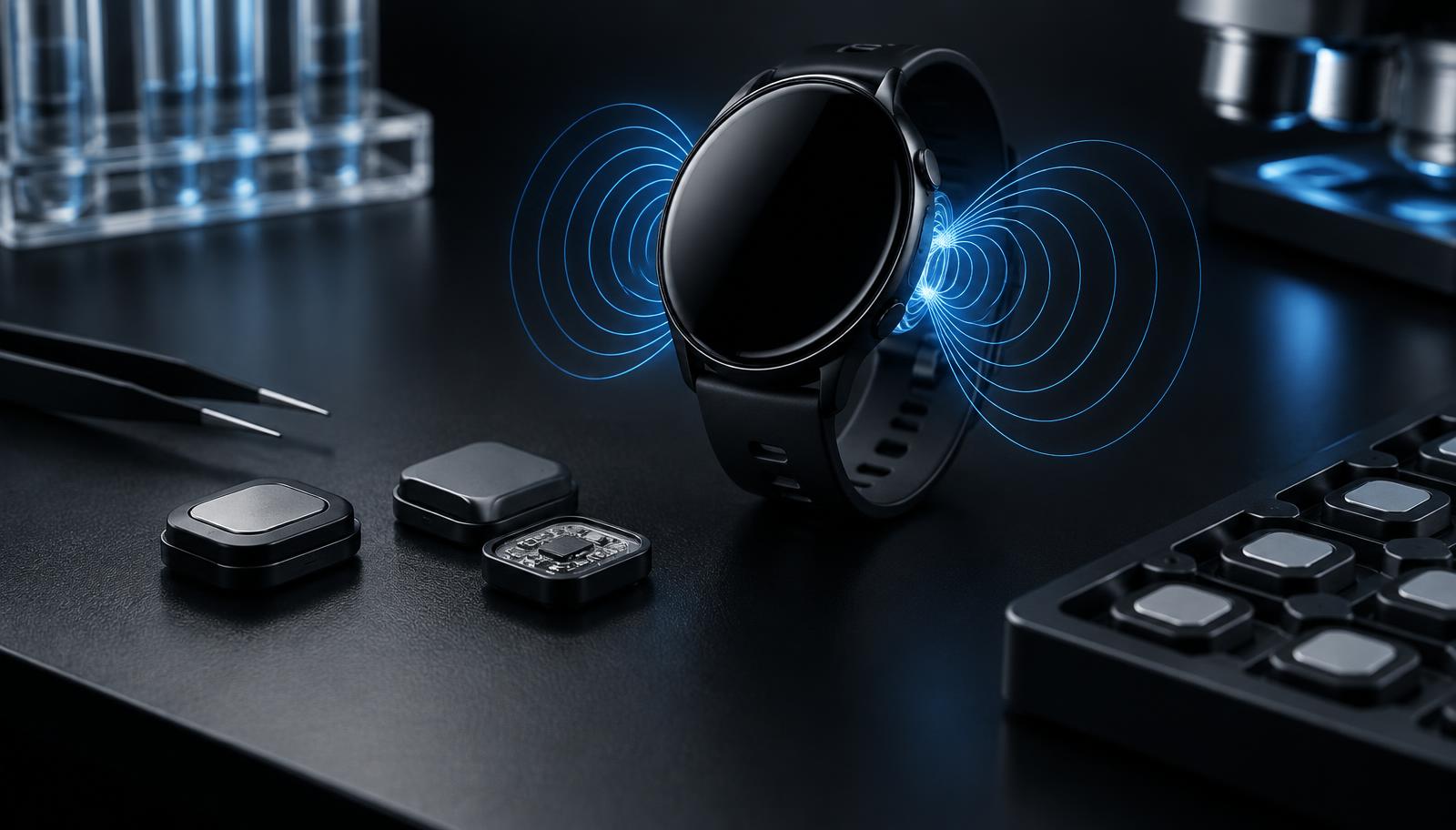
Every consumer smartwatch on the market today runs into a familiar physical bottleneck at the wrist. Optical sensors can struggle with sweat, variations in skin pigmentation, and motion artifacts, while electrical contact pads require consistent, conductive skin adhesion that degrades during normal movement. For hardware makers, the skin has always been a noisy, variable barrier between consumer sensors and the human nervous system.
That dynamic became significantly more interesting this week. European regulatory disclosures under the Digital Markets Act revealed that Apple acquired key technology assets and talent from Sonera, a UC Berkeley spinout that engineered room-temperature biomagnetic sensors on semiconductor chips. Instead of relying solely on electrical voltage across the skin, Sonera designed sensors to detect the subtle magnetic fields generated by biological currents without requiring tight conductive contact.
In this deep dive, we are going to look at:
- Why this matters now
- What actually happened in the transaction
- The obvious read versus the deeper signal
- The emerging market map: How Big Tech is dividing neural sensing
- The Evidence Ladder: What is proven versus what remains experimental
- Strategic history: Apple has used this component playbook before
- The global picture: How international health systems alter adoption
- The economic equation: Who pays, who earns, and who gets disrupted
- The HealthTech Investor's Signal: Capital allocation, exposure, and catalysts
- What could break the thesis: Real-world engineering and regulatory friction
- Four concrete milestones to watch over the next 12 to 24 months
- The bottom line for healthcare leaders and device strategists