Good morning, HealthTech insiders. A 48-year-old man in London had a brain tumour removed this week while a live AI system analysed the surgical video feed in real time, highlighting every hidden vessel and nerve the surgeon needed to avoid. The trial ran at University College London Hospitals, funded by the National Institute for Health and Care Research and Google, and it worked. The patient's sight was saved.

At the exact same time, a musculoskeletal telehealth company is paying up to $300M to buy Headspace, and Rock Health confirmed that digital health pulled in $7.4B of venture funding in just the first half of 2026. All three stories point in the same direction: HealthTech has moved past the 'could AI do this?' phase, and is now deep in 'who owns this when it works?' territory. The competition today is not over technology. It is over platform, distribution, and clinical legitimacy.

CLINICAL AI

In today's Signal:

  • UCLH neurosurgeons: perform world's first live AI-assisted brain tumour removal, saving a patient's sight in a Google- and NIHR-funded trial.

  • Sword Health: moves to buy Headspace for up to $300M in cash, betting physical therapy and mental health belong in one platform.

  • Rock Health: $7.4B raised across 244 digital health deals in H1 2026, with 19 companies hoovering up 45% of all capital in megadeals

  • Follow the money: Sword-Headspace signals behavioral health M&A is accelerating; Temple acquires London longevity clinic Longevous

  • Quick Hits: NHS mental health trust cuts admin by 68% with ambient AI; Harrogate deploys AI for breast cancer diagnostics; National Nurses United rallies against Palantir in eight US cities

LATEST DEVELOPMENTS

CLINICAL AI
1. A surgeon just got a live AI copilot in the operating theatre, and the results held up.

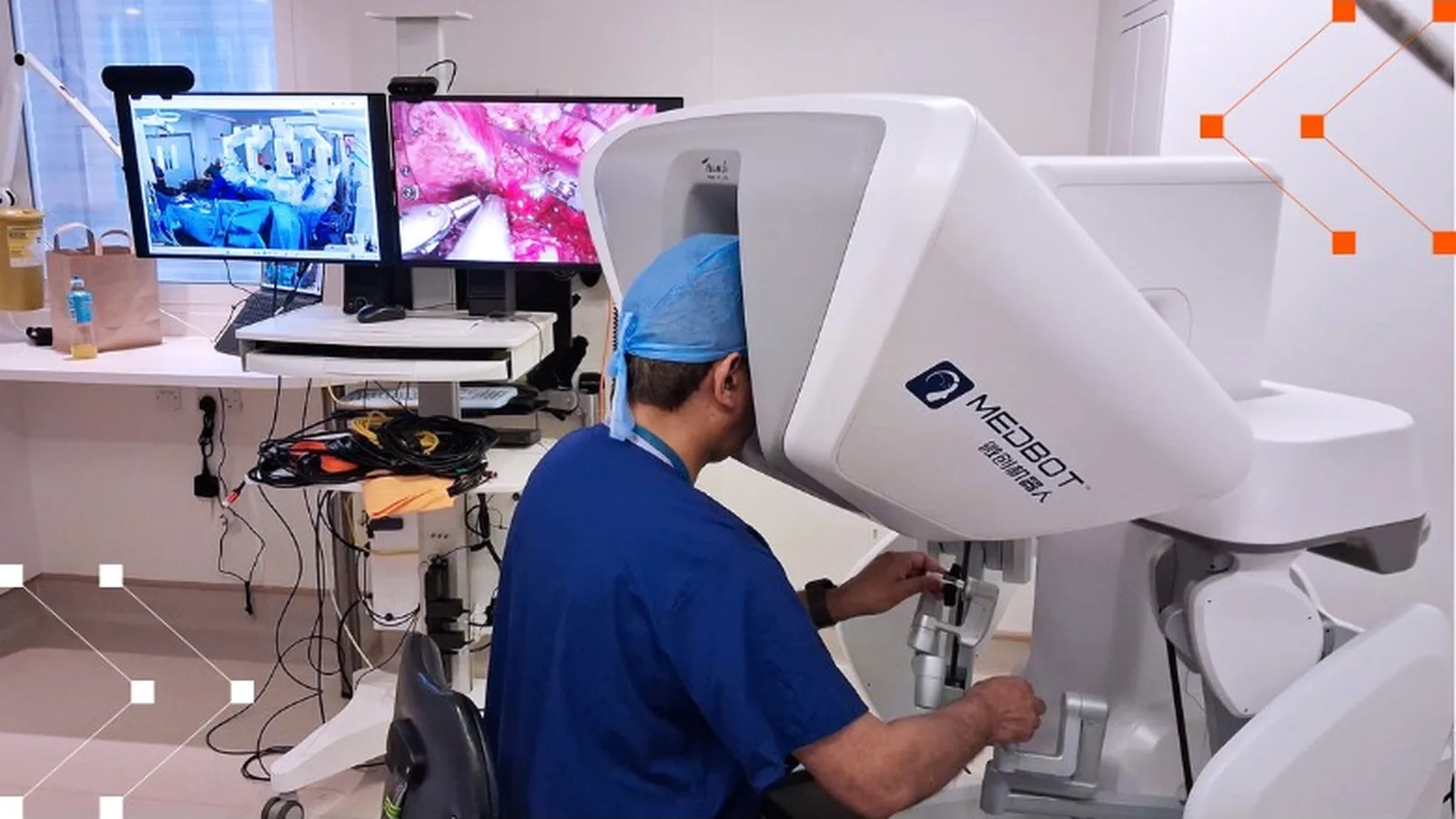
Prof. Hani Marcus and Mr. Danyal Khan, lead surgeons on the world's first AI-assisted brain tumour removal. Source: UCLH / BBC News, August 27, 2026

The signal: Neurosurgeons at University College London Hospitals completed the world's first AI-assisted live brain tumour removal on August 27, with an AI system reading real-time surgical video to flag hidden blood vessels and nerves the surgeon could not directly see.

The details:

  • Patient Rhys Hibbert, 48, had an 11mm pituitary tumour pressing on his optic nerves. Without surgery, he faced progressive blindness. The tumour sits millimetres from the carotid arteries and optic nerves at the base of the skull, making it one of the most risk-loaded approaches in neurosurgery.

  • The AI system, developed at the UCL Hawkes Institute and trained on hundreds of surgical videos, runs on an NVIDIA Clara IGX platform. It analysed the live endoscope feed and projected colour-coded overlays showing where critical structures were most likely hiding behind tissue, in real time. Lead surgeons: Prof. Hani Marcus and Mr. Danyal Khan at the National Hospital for Neurology and Neurosurgery.

  • The trial was funded by the National Institute for Health and Care Research (NIHR) and Google. A larger clinical trial is planned. The average UK neurosurgeon performs 10-20 of these procedures a year; this AI was trained on more surgeries than most surgeons see in a career.

Why it matters: Every autonomous clinical AI story so far has been about things AI does instead of a clinician. This one is about AI working in the room, in real time, as the surgeon's eyes into tissue they cannot directly see. That is a fundamentally different use case, and if the larger trial validates it, the 'AI in the OR' category gets a very clear proof point to build from.

REGULATION & TRIALS
2. Sword Health is buying Headspace, and a $300M bet is about more than mindfulness.

The signal: Sword Health, a virtual physical therapy platform, announced it is acquiring Headspace in an all-cash deal reported by Axios at up to $300M, with the deal closing September 14.

The details:

  • Sword Health started as an AI-guided musculoskeletal care business (back pain, knee rehab) and has since added women's health and cardiometabolic care. Headspace is a mindfulness and digital mental health app that raised $321M from investors. Combined, the two give Sword a full body-and-mind platform that employer benefits teams can buy as one contract.

  • The deal closes into a crowded space. Spring Health already bought Alma in May 2026. Talkiatry raised $210M in a megadeal this year. The behavioral health platform race is now explicitly about scale: who has the largest network for employers to buy in a single purchase.

  • Headspace had been through multiple ownership changes after the Ginger merger and subsequent OrangeDot restructuring. The acquisition gives Sword the brand recognition and consumer mindfulness user base that employer wellbeing programs prize.

Why it matters: Sword is making a classic infrastructure play: own the full spectrum of an employer's health spend rather than compete as a single-condition point solution. The real question is whether a PT-first platform can credibly hold a mental health brand without clinical dilution, and whether employers will pay a premium for a combined offering they could not previously get from one company.

CAPITAL & DEALS
3. $7.4B into digital health in six months. Here is where the money is actually going.

Source: Rock Health. H1 2026 mega deals made up 45% of digital health funding.

The signal: Rock Health's H1 2026 report confirms that digital health venture funding is back in growth mode: $7.4B raised across 244 deals, up $1B versus H1 2025, with AI rewriting where and how capital concentrates.

The details:

  • Nineteen companies pulled in 20 megadeals (rounds of $100M or more), representing 45% of all capital on just over 8% of deals. Biggest H1 names: WHOOP ($575M), Verily ($300M), Talkiatry ($210M), eMed ($200M), OpenEvidence ($250M), Forus ($160M), Aidoc ($150M). Mental health and weight management were the top two funded clinical areas.

  • Rock Health's analyst note: 'As AI changes what is easy to build, competitive advantage increasingly comes from qualities that are difficult to replicate.' Founder clinical domain expertise, proprietary workflow access, and white-glove service after the sale are now the durable edges. Pure technical differentiation is eroding as foundation models commoditise the build layer.

  • Digital health M&A ran at 115 acquisitions through H1, ahead of 2025's pace. No digital health IPOs yet in 2026, but Oura, WHOOP, and Virta Health are named as candidates. GLP-1 adjacents drew three megadeals; wellness peptides (Superpower, Protocole) attracted early seed as investors hunt for the post-GLP-1 body-composition layer.

Why it matters: The concentration of 45% of capital into a small number of megadeals is not a bull market returning equally. It is a maturation signal: late-stage companies that proved their model are getting funded at scale, while early-stage bets face a 'prove you are different in a way AI cannot commoditise' test. Series A HealthTech founders are raising into a fundamentally different market than the megadeal names above.

QUICK HITS

💰 FOLLOW THE MONEY

  • The deals: Sword Health acquires Headspace for up to $300M (all-cash, closes Sept. 14); Temple (founded by Deepinder Goyal) acquires London longevity medicine practice

    Longevous (undisclosed; Dr. Robert Mohr joins as CMO, Dr. Avi Roy joins as science lead); Rock Health confirms $7.4B in H1 2026 across 244 deals with 20 megadeals from 19 companies.

  • The pattern: Both acquisitions follow the same logic: buy clinical credibility you cannot build as fast as you can buy it. Sword buys Headspace's mindfulness legitimacy and consumer brand; Temple buys Longevous's physician team to validate its Entropy wearable metric before launch. Platform builders are absorbing clinical expertise through M&A because the capital environment rewards broad ownership over narrow excellence.

🩺 THE CLINICIAN’S SIGNAL

  • On the UCLH AI brain surgery: A real-time video AI in the OR is not the same risk profile as a diagnostic AI reading a pre-op scan. The question surgeons will have, rightly, is: what happens when the AI's overlay is wrong and the surgeon is already mid-dissection? The larger trial needs to capture near-miss events and false positives, not just successful outcomes.

  • On Sword Health buying Headspace: Employer benefits purchasing is one thing. Clinical integration is another. Patients with serious mental health needs, not just mindfulness users, will look at this platform and ask whether Sword's clinical infrastructure is built to support them. Substance of the combined clinical pathway matters more than the brand combination.

  • On the Rock Health H1 2026 data: The two most-funded clinical areas, mental health and weight management, are where AI-assisted coaching blurs most easily into clinical decision-making without the oversight structures. More capital flowing in does not automatically mean better patient outcomes.

🛠️ Trending HealthTech AI Tools & Startups

  • Abridge: Now connected to NVIDIA clinical foundation models, the American Diabetes Association, and the AAFP for clinical validation, plus smart-room partners Artisight and hellocare.ai. Enterprise-wide: 300+ health systems, 250M patients.

  • OpenEvidence: $250M Series D. Medical-society partnerships for citation-grade AI clinical answers. Rapidly growing as a physician-grade alternative to general LLMs.

  • UCL Hawkes Institute Surgical AI (NVIDIA Clara IGX): Live pituitary surgery real-time video analysis with colour-coded anatomical overlays. First of its kind in the OR. Not yet commercially available.

  • Tempus AI ECG-PH: 510(k) clearance for AI-assisted pulmonary hypertension screening from standard 12-lead ECG. Third cardiovascular clearance for Tempus.

  • Temple: Founded by Deepinder Goyal. Forehead-worn sensor tracking cerebral blood flow and metabolic 'Entropy' score. Acquired Longevous (Dr. Robert Mohr as CMO). Pre-launch.

  • Sword Health: Led by CEO Virgilio Bento. AI-guided virtual PT, now acquiring Headspace for up to $300M to build physical + mental employer benefits stack. $495M raised.

  • Cityblock Health: $116M Series E (General Catalyst) + Homeward Health acquisition (all-stock). 120M Americans on government-funded insurance targeted.

  • Hyperfine (NASDAQ: HYPR): FDA clearance for Optive AI update on Swoop portable brain MRI. 12 commercial units sold Q2 2026, up 50% YoY.

📣 Highlights: Events, Lists & Deep Dives

That's it for today!

AI in the operating room. A musculoskeletal company buying a mindfulness app. And $7.4B flowing into a sector that is rapidly sorting into 'platforms with distribution' and 'everything else.' The competition today is not about who can build the AI. It is about who gets trusted with the patient, the employer, and the workflow. I think that sorting is happening faster than most founders realise.

Was today's Signal worth your time? Reply and let me know what you'd add or cut. Your feedback keeps this sharp.

How did we do today?

See you tomorrow,

Dr. Dereck Mush, MD, MBA

The HealthTech Signal is independently funded. Sponsorships help us invest in better reporting, research, and a stronger newsletter for our readers. Want to reach HealthTech founders & executives while supporting the Signal? Get in touch.

Was this email forwarded to you? Sign up here.

Until tomorrow,
The HealthTech Signal