The opening scenario is illustrative, not a reported patient encounter.
A GP in Brisbane finishes a consultation. Her AI scribe has already drafted the note. A newer version of the same product goes further: it highlights a finding, suggests a likely diagnosis and proposes a referral. She accepts the suggestion because it looks right. Later, someone asks why the software suggested it. Nobody can say. The note is fine. The reasoning is invisible.
That gap, between a useful output and a visible reason for it, is what Australia's amended exemption for clinical decision support software addresses. The changes took effect on November 1, 2026. The TGA says they clarify rather than expand the rules. But read alongside the TGA's review of AI scribes, published on October 16, they draw a much sharper line around which clinical AI can stay outside full device regulation. Below we set out what changed, how it applies to scribes and other generative tools, how it compares with the US, EU and UK, and what builders and buyers should do now.
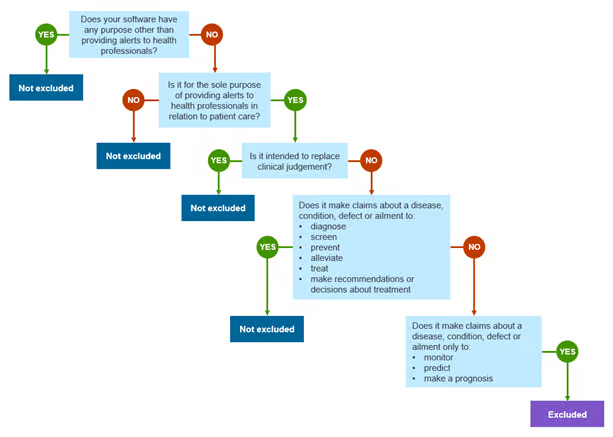
The clarified transparency criterion is important for clinical AI: software that meets the medical-device definition must satisfy all applicable CDSS exemption criteria, including enabling the clinician to interpret and verify its recommendations.
In This Deep Dive
- Why this matters now
- What actually happened
- The obvious read versus the deeper signal
- Category map and taxonomy
- Evidence Ladder
- Regulation, payment and international divergence
- Capital flows and bottom-up economics
- The HealthTech Investor's Signal
- Implementation priorities
- Forward Intelligence
- The Bottom Line
Why this matters now
AI scribes spread through Australian general practice faster than almost any clinical software before them. The TGA's environmental scan found about 100 digital scribe suppliers operating in Australia. Many started as transcription and documentation tools, which are generally unlikely to be medical devices. As generative AI improved, suppliers added features that analyse clinical information, identify relevant findings and produce outputs that could influence diagnosis or treatment. The TGA notes that software doing those things may be regulated as a medical device under the Therapeutic Goods Act 1989.
Australia matters beyond its own market. Its regulator is a member of the International Medical Device Regulators Forum, its software rules are often read alongside those of the US and Europe, and several of its AI scribe companies are expanding abroad. How Australia draws the line for generative clinical tools is a preview of questions every regulator is now facing.
Certainty: (A) scan figures, quotes and findings per the TGA’s Digital scribe review outcomes, published October 16, 2026; (B) our read of Australia's international relevance.
What actually happened
The amended exemption
The TGA announced the amendments on September 8, 2026. They were made through the Therapeutic Goods Legislation Amendment (2026 Measures No. 1) Regulations 2026, registered as F2026L01167, and came into effect on November 1. The changes followed a consultation in 2024. The TGA states that the amendments "do not change the scope of the CDSS exemption or introduce new regulatory requirements," and that they "provide greater clarity about when the exemption applies."
- Assisting, not deciding: exempt software must not be intended to provide a diagnosis or treatment decision. The explanatory materials make clear this includes IVD software.
- Images and signals: the criterion excluding software that processes or analyses medical images or signals from medical devices was reworded. It drops the word "directly" and now names compressing and decompressing alongside processing and analysing.
- Visible logic: exempt software must display the guidelines, calculations or logic behind its output, so a health professional can readily interpret and verify the recommendation.
- No grace period: the rule applies to software manufactured before November 1 if it is intended for use on or after that date.
Exempt does not mean unregulated. Software that meets the criteria does not need to be included on the ARTG, but it still has to be notified to the TGA, meet the Essential Principles, report adverse events and follow advertising rules.
The scribe review
On October 16, the TGA published the outcome of its digital scribe review. Of about 100 suppliers identified, 40 answered a voluntary survey, and the TGA examined 12 products in detail. Eight had functions likely to meet the medical device definition, two needed more information and two appeared unlikely to qualify. None of the suppliers had identified its product as a medical device, and none of the 12 was included on the ARTG.
The TGA did not name the eight. It also stressed that it "did not test any digital scribe products, check the safety and performance, or assess compliance with detailed medical device regulatory requirements." The finding is about function and intended purpose, not safety. The regulator said it will undertake targeted compliance activity and publish further guidance.
Certainty: (A) legislative instrument, dates, criteria and TGA statements per TGA and the Federal Register of Legislation; (A) review figures and named products per TGA’s Digital scribe review outcomes, published October 16, 2026; (B) individual company responses as reported by trade press.
The obvious read versus the deeper signal
The obvious read: Australia tidied up a regulation and ran a review of AI scribes. The TGA itself says the exemption's scope is unchanged. Most scribes are documentation tools, and documentation is not a device.
The deeper signal: the transparency criterion creates a practical test that generative AI struggles to pass. A rules-based tool, such as a dosing calculator or a guideline engine, can show exactly which rule or calculation produced its suggestion. A large language model that reads a consultation transcript and suggests a diagnosis cannot easily show its working in a way that lets a clinician verify it. If a generative feature makes clinical suggestions and cannot meet the visible-logic criterion, it is unlikely to fit within the exemption, and it moves toward full device regulation and ARTG inclusion.
Three implications follow. First, product design becomes regulatory strategy. Scribe makers can keep their products as documentation tools, add clinical features that show their sources and reasoning, or accept device regulation for features that cannot. Each path has different costs. Second, buyers get a simple procurement question: can the clinician see why the software suggested this? Health services that ask it will push vendors toward transparent designs. Third, a disclaimer alone does not determine whether software is a medical device. The TGA has said in plain terms that labeling a product "not a medical device" does not make it one.
Certainty: (A) criteria and TGA statements; (B) our analysis of how generative AI interacts with the transparency criterion; (C) forward-looking implications for product strategy.