
Europe does not lack ambitious presentations about AI in healthcare. It needs harder conversations about who is responsible when that AI gets connected to a national health system.
On November 12, 2026, Portugal's SPMS chairman Luís Filipe Loureiro Goes Pinheiro joined Imperial College London AI researcher Aldo Faisal and Washington Post journalist Elizabeth Dwoskin at Web Summit's Health Summit in Lisbon. The session was called “Navigating AI in European health.” The panel brought together two complementary perspectives: frontier research and the practical work of delivering technology across a national health system.
Who was on the European health AI panel?
Faisal was listed as professor and director of the UKRI Centres in AI for Health at Imperial College London. Goes Pinheiro appeared as chairman of SPMS, the Portuguese body responsible for shared services and health information systems. Dwoskin was identified with The Washington Post. The three were pictured together in official event photography.
The discussion focused on bridging frontier AI research and national health-system implementation, particularly for agentic AI. That framing is significant: research and deployment are not the same discipline.
What is SPMS Portugal?
SPMS, Serviços Partilhados do Ministério da Saúde, is a Portuguese public-sector organisation supporting the health ministry through shared services, including digital systems. Its role is distinct from a startup's: it helps deliver public-sector digital services. Its position matters because a public healthcare network cannot introduce AI solely on the strength of an impressive vendor demo.
A national system must think about procurement, data protection, cybersecurity, accessibility, clinician workflow, monitoring, accountability and what happens when software fails. Agents that merely draft information raise one set of questions. Agents allowed to trigger actions raise another.
Those questions become especially difficult in health systems with legacy software, fragmented records and staff already under considerable administrative pressure. A useful tool must improve the work without introducing new layers of friction.
The opportunity for European health systems
For European health systems, connecting research expertise with operational delivery means examining more than model performance. Governance, integration and the needs of staff using the service determine whether an AI tool is useful in practice.

Why this is different from Portugal's waiting-times story
The HealthTech Signal has separately covered the evidence question surrounding AI and waiting times in Portugal. That debate asks whether technology has measurably improved access or throughput. This panel's published topic was a different one: how advanced AI might fit into European health systems at all.
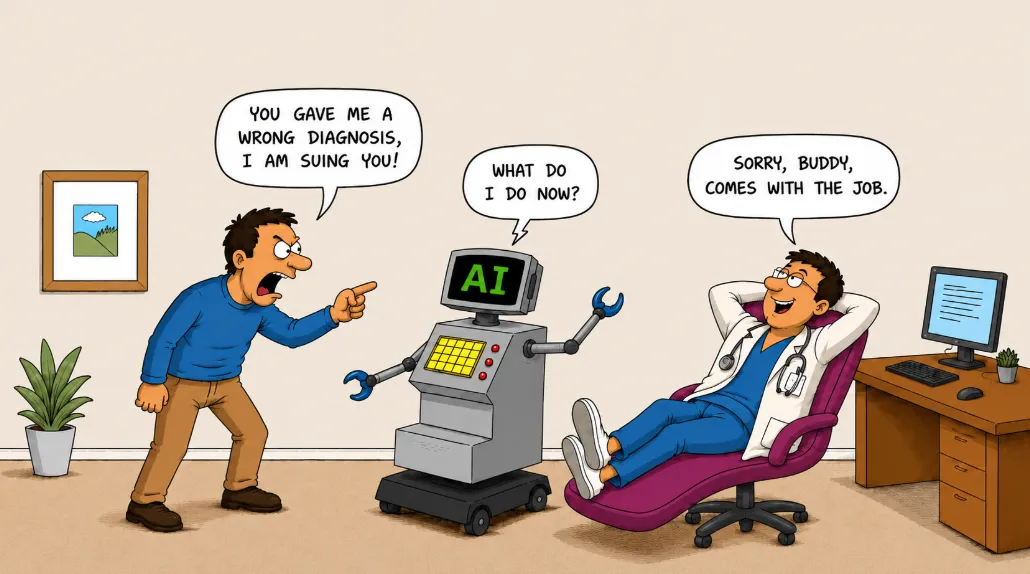
Before celebrating agentic AI as the next healthcare revolution, ask three practical questions. Who authorises the agent's actions? Can its performance be independently audited? And what happens to the patient or professional when the system is wrong?
Without specific answers, “safe deployment” remains an ambition, not an operational plan.
Why an AI researcher and a public-system operator need different answers
A research lab and a national health system may be talking about the same model while assessing very different risks. A researcher can evaluate an AI system in a controlled environment, measure performance on a chosen dataset and publish what the model appears capable of doing. A public healthcare organisation must decide whether that same system is safe, maintainable, affordable and useful in the middle of existing workflows.
The difference becomes especially important with agentic AI. A conventional predictive model might provide a score for a clinician to interpret. An agent may be configured to retrieve records, prepare messages, trigger a process or interact with other software. The first kind of tool may influence a decision. The second may also be allowed to perform an action. That additional autonomy changes the governance question.
An agent that makes a mistake in a demonstration can be corrected and rerun. In a live healthcare system, an incorrect action may be recorded, communicated or acted upon before anyone recognises the problem. This is not an argument that autonomous tools are unusable. It is an argument for defining their authority narrowly and testing the surrounding controls as seriously as the model itself.
That makes the pairing of Aldo Faisal and Luís Goes Pinheiro a useful one. Imperial College represents part of the research and evaluation ecosystem. SPMS represents the operational infrastructure through which digital services reach Portugal's public health system. Their positions on stage reflect the two sides of a difficult deployment problem. Together, their areas of expertise illustrate how important it is to connect research progress with practical health-system delivery.
SPMS is an infrastructure story, not a startup story
For international readers, the role of SPMS needs explaining because a government technology body can be easy to overlook amid dozens of AI startups. Portugal's Serviços Partilhados do Ministério da Saúde supports shared services and health information systems for the public sector. Its responsibilities connect to the practical digital environment in which new technologies must operate.
That environment involves more than procurement. Systems have to exchange information, remain accessible to authorised staff, meet security requirements and continue functioning when a product changes or a vendor fails. An AI agent that depends on records being available in a particular format will not become useful simply because it performed well during a conference demo.
This is why interoperability should be treated as a condition of deployment rather than a decorative promise. If an AI system is supposed to help staff complete an administrative task, it must work with the actual tools and permissions available to those staff. Otherwise the promised time saving can disappear into manual copying, extra logins and double-checking.
Public systems also face a governance challenge that individual startups may underestimate. There must be clarity about who owns the process, who maintains the software, who can change an agent's permissions and who responds when outputs are wrong. Where a system takes action on behalf of a user, it should be possible to identify that authority and understand its limits.

Which European rules would matter?
A conference panel can use the phrase European healthcare AI, but Europe is not one uninterrupted operating environment. Healthcare delivery arrangements differ among countries, as do institutional purchasing practices and technical infrastructures. EU legislation provides important common requirements, yet it does not remove the need to make products work within national services.
Data protection is an obvious consideration because medical records contain highly sensitive information. The question is not only whether data can be processed in principle. Organisations must understand the purposes, access rights, safeguards and responsibilities associated with the processing. A system that can act across multiple applications makes the mapping of data flows and permissions especially important.
Medical-device requirements may also become relevant depending on the software's intended use. But not every administrative AI agent is automatically a medical device, and classification depends on what the software is designed and marketed to do. The same caution applies to the EU AI Act: a particular obligation depends on the system, its use and the applicable provisions, not on the fact that its marketing material includes the term AI.
These distinctions can feel tedious beside a product demonstration. They are precisely what public buyers need to resolve before an ambitious concept becomes routine care.
Procurement should begin with the problem, not the model
Suppose a hospital hopes to reduce administrative time spent moving information between systems. The first useful step is to measure the existing workflow. How many people participate? Which actions are repetitive? Where do delays occur? What information is needed to finish the work, and which decisions require professional judgement?
Only then does it make sense to ask whether an agent is the right tool. Some tasks might be improved by a simple integration or a better interface. Others may benefit from AI-assisted summarisation but still need human review. A smaller number may be suitable for greater automation. Choosing autonomy as the starting requirement risks making a straightforward software problem unnecessarily complicated.
A sensible pilot would define the target outcome and the unacceptable failure modes before deployment. It would measure staff time, completion quality and error handling, not merely how many tasks the system says it processed. Staff should be able to challenge unexpected behaviour and understand how the system is monitored after the pilot ends.
Another practical issue is vendor dependence. Public health systems cannot redesign essential services every time a startup changes its commercial strategy. Buyers need realistic assurances about support, migration and how work continues if an AI service becomes unavailable. Those questions are part of responsible innovation, not evidence of resistance to it.
A useful direction for European healthcare AI
Bringing public-system delivery and AI research into the same discussion highlights the practical conditions for adoption: clearly defined workflows, governance and evidence that a tool improves the service it enters.
For a public health system, the practical priorities are clear: identify a workflow suited to the technology, establish safeguards before an agent can act and define the evidence needed for procurement. Human authority should remain explicit even when further automation becomes technically possible.
The answer to whether Europe is ready for agentic AI in healthcare will not be found in a single stage session. It will emerge from organisations that can connect research evidence, governance and everyday delivery. The session's line-up illustrates the right conversation to have. The next step for European health systems is to turn these discussions into carefully evaluated, practical deployments.