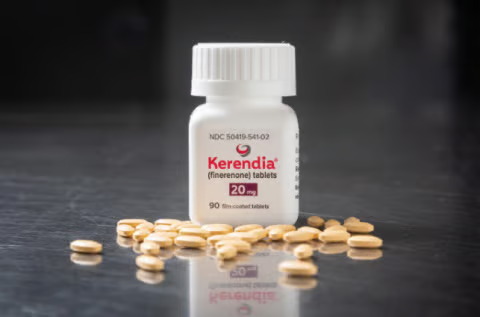

Good morning, HealthTech insiders. After more than three decades with few new treatment options for chronic kidney disease associated with type 1 diabetes, patients have one more. Yesterday, the FDA approved Bayer’s Kerendia (finerenone) for this population. The decision rests on a reduction in urinary albumin, a marker of kidney damage. Whether that translates into better long-term kidney outcomes in these patients remains an important question.
Two other developments show how companies are trying to change the evidence and delivery of care. Altis Labs raised $25 million to develop AI measures that could help oncology teams read treatment signals earlier. Sling Therapeutics secured $123 million as it tests an oral treatment for thyroid eye disease in Phase 3.
In today's Signal:
Bayer’s Kerendia gains a new indication: The FDA approves finerenone for adults with chronic kidney disease associated with type 1 diabetes.
Altis Labs raises $25 million: Its AI imaging approach aims to give cancer drug developers earlier evidence of treatment effect.
Sling Therapeutics raises $123 million: The company begins Phase 3 testing of an oral thyroid eye disease treatment.
What we’re watching next: Long-term kidney outcomes, validation of AI trial endpoints, and whether an oral therapy can offer patients a useful alternative to infusions.
Hiring Globally? These Events Are For You
If you’re building an international team, another company has likely already wrestled with the same questions you’re facing.
Oyster’s events bring together founders, HR leaders, and global employment experts to share what they’re seeing, testing, and learning in the real world.
How do you hire in a new country? When does EOR make sense? How should you approach global compensation? And how do you stay compliant when the rules change from one market to the next?
Come for the insights, stay for the ideas you can actually take back to your team.
LATEST DEVELOPMENTS
NEPHROLOGY & DIABETES
1. FDA Expands Kerendia Approval to CKD in Type 1 Diabetes

Source: Business Wire
The FDA has approved Bayer’s Kerendia (finerenone) for adults with chronic kidney disease associated with type 1 diabetes. The new indication is to reduce urinary albumin-to-creatinine ratio (UACR), which is expected to reduce the risk of sustained kidney function decline and end-stage kidney disease.
The details:
In the Phase 3 FINE-ONE trial, finerenone added to usual care reduced UACR by 25% relative to placebo over six months.
Bayer describes Kerendia as the first FDA-approved treatment option in more than 30 years for adults with CKD associated with type 1 diabetes.
The trial measured a kidney damage marker. It did not establish a reduction in kidney failure or cardiovascular events in this specific population.
The Signal: This gives clinicians a new option for a group that has long needed one. The next test is what happens beyond the six-month biomarker result: how well the treatment works and is tolerated in routine care, and whether longer follow-up confirms the kidney benefit the approval anticipates.
ONCOLOGY AI & CLINICAL TRIALS
2. Altis Labs Raises $25M for Predictive AI Oncology Endpoints

Toronto-based Altis Labs has closed a $25 million Series A round co-led by OrbiMed and Qiming Venture Partners USA. Its software analyzes medical images to look for earlier signs that a cancer treatment may improve patient outcomes.
The details:
The company says a retrospective analysis of Johnson & Johnson’s Phase 3 MARIPOSA trial detected a treatment effect earlier than the trial’s final survival readout.
Altis plans to expand its models across cancer types and work with more biopharma sponsors.
Its AI-generated measures remain under development as potential trial endpoints. A promising retrospective result does not, by itself, make one an accepted substitute for overall survival.
The Signal: Oncology teams often have to make expensive decisions before they know whether patients will live longer. Better early signals could help, provided they hold up across independent trials, cancer types and treatments. That validation is the story to follow.
SPECIALTY PHARMA & OPTHALMOLOGY
3. Sling Therapeutics Closes $123M Series C for Oral Thyroid Eye Disease Treatment

Sling Therapeutics has raised $123 million in Series C financing led by Forbion. The company has also dosed the first patients in ORBIT, a global Phase 3 trial of linsitinib, its oral treatment candidate for active thyroid eye disease.
The details:
Linsitinib targets IGF-1R, a pathway already targeted by approved thyroid eye disease treatments.
The ORBIT trial will compare oral linsitinib with placebo over 24 weeks, with reduction in eye bulging as its primary endpoint.
The FDA has granted linsitinib Fast Track designation. It remains an investigational treatment.
The Signal: An effective pill could remove some of the travel and treatment burden associated with infusions. ORBIT now needs to show whether linsitinib’s benefits and safety profile hold up in a further pivotal trial before that convenience can matter in clinical practice.
QUICK HITS
👀 WHAT WE'RE WATCHING NEXT
1. Kerendia after approval: How clinicians use finerenone alongside existing care for type 1 diabetes and CKD, and what longer-term evidence shows about kidney outcomes and potassium-related safety.
2. AI endpoints beyond one trial: Whether Altis’s imaging measures reproduce their results in independent datasets and can meet the standards needed for broader use in oncology trials.
3. An oral option for thyroid eye disease: Whether Sling’s Phase 3 results support the efficacy, tolerability and practical advantages suggested by earlier research.
💰 FOLLOW THE MONEY
The deals:
Altis Labs: $25M Series A to develop AI measures for oncology trials.
Sling Therapeutics: $123M Series C to advance linsitinib through Phase 3.
Ayble Health: $16M Series A led by Neon for its virtual digestive health clinic.
The pattern: These investments address different bottlenecks: reading trial results sooner, making specialty treatment easier to receive, and bringing coordinated care to patients outside a specialist’s office. Each still has a distinct proof point to meet, from clinical validation to patient outcomes and sustainable delivery.
📆 UPCOMING HEALTHTECH EVENTS
Milken Institute Future of Health Summit 2026: November 11-13 | Washington, DC. Health policy, biomedical innovation, access and finance.
HLTH USA 2026: November 15-18 | Las Vegas, NV. Digital health, clinical AI and health system transformation.
RSNA 2026: November 29-December 3 | Chicago, IL. Medical imaging, radiology research and clinical technology.
🛠️ Trending HealthTech AI Tools
Ambience Healthcare: Ambient clinical documentation, coding support and clinical documentation integrity tools for health systems.
iDFAX: A clinical document intelligence project designed to help sort incoming medical faxes and move relevant information into care workflows.
Nabla: An ambient documentation platform that also offers dictation and coding support within EHR workflows.
🛠️ Trending HealthTech AI Startups
Ayble Health: Building a virtual, multidisciplinary clinic focused on digestive health.
Altis Labs: Testing whether AI analysis of routine trial images can provide useful earlier evidence in oncology development.
Sling Therapeutics: Running a pivotal trial that could determine whether an oral IGF-1R inhibitor becomes a treatment option for thyroid eye disease.
DECISION INTELLIGENCE
Highlights: Deep Dives & Industry Reports
What Kerendia’s New Approval Does and Does Not Prove.
A closer look at the difference between reducing a kidney damage marker and demonstrating fewer cases of kidney failure.Can AI Imaging Change Oncology Trial Decisions?
What Altis’s MARIPOSA analysis suggests, and what further validation would be needed before AI measures could carry more weight in trials.The Case for an Oral Thyroid Eye Disease Treatment.
How convenience, safety and clinical results will shape linsitinib’s prospects if ORBIT succeeds.
Which of today’s developments should we follow most closely? |
That's it for today!
A new CKD indication, an earlier way to read oncology trials, and a potential pill for thyroid eye disease all address a form of waiting. Patients wait for better options. Drug developers wait for evidence. People receiving infusions spend time getting to treatment.
The question in each case is what the next set of results will show.
How did we do today? |
See you tomorrow,
Dr. Dereck Mush, MD, MBA
The HealthTech Signal is independently funded. Sponsorships help us invest in better reporting, research, and a stronger newsletter for our readers. Want to reach HealthTech founders & executives while supporting the Signal? Get in touch.
Was this email forwarded to you? Sign up here.
Until tomorrow,
The HealthTech Signal
Related reading

The HealthTech Signal
The FDA asked hard questions about AI therapy chatbots. It has not yet answered them
Pig Kidney Transplants Are Now in Human Trials. Here Is What EXPAND and Its Rivals Actually Have to Prove

Breaking the PMA Bottleneck: How FDA's Class II Reclassification Accelerates Precision Oncology
Keep exploring

