Modular Robotics in Soft-Tissue Surgery: The Strategic Logic of Stryker's $400M CMR Bet

Dr. Dereck Mush, MD, MBAThe Daily SignalOctober 27, 2026
PLUS: Scarlet Secures $50M Series B to Fast-Track AI Medical Device Certification

Good morning, HealthTech insiders. Stryker is making a $400 million move into soft-tissue surgical robotics, backing CMR Surgical’s Versius system with exclusive US distribution rights and an option to buy the company. That puts a major hospital supplier behind a challenger to da Vinc, and gives the robotics race a powerful new commercial engine.
Elsewhere in today’s Signal, Scarlet has raised $50 million to speed up medical software certification, while Teal Health is bringing cervical cancer screening into the home with $22 million in Series A backing. Three different bets, one shared ambition: get promising technology past the barriers that keep it from reaching patients.
In today's Signal:
Stryker's $400M Robotic Move: Securing exclusive US distribution and buyout rights for CMR Surgical's modular Versius system to enter soft-tissue surgery.
Automating AI Medical Clearances: Scarlet raises $50M Series B to compress 18-month FDA and EU MDR review queues into continuous software verification.
At-Home Cervical Cancer Screening: Teal Health discloses $22M Series A for its FDA De Novo-authorized self-collection wand ahead of 2027 federal coverage rules.
Capital Pattern Analysis: Why healthcare venture allocation is heavily rewarding friction-removal platforms across surgery, regulation, and preventive diagnostics.
Instead of running your deals across scattered email threads and forgotten attachments, Aligned brings everything into one shared deal workspace.
Buyers get a single place to evaluate, loop in their team, and say yes. Sellers get visibility into what is actually happening when they're not in the room and AI Deal Insights that help you act accordingly, before it's too late.
Best part? Your first deal room takes only minutes to stand up.
LATEST DEVELOPMENTS

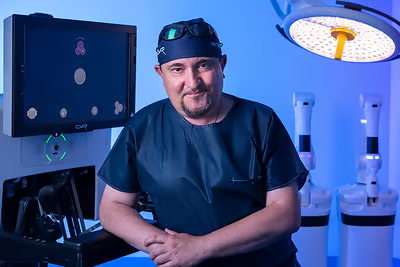
Thoracic surgeon Patrick Bagan with CMR Surgical’s Versius robot at Argenteuil Hospital in France. Stryker’s new alliance backs the Versius portfolio’s expansion. Credit: CMR Surgical / PR Newswire
US medtech giant Stryker announced an exclusive US distribution agreement and a $400 million strategic investment in UK-based CMR Surgical, including an explicit option for outright acquisition, marking Stryker's direct entry into soft-tissue multi-port robotic surgery.
The details:
Commercial Engine: Stryker will distribute CMR's Versius surgical robot across US hospitals and ambulatory surgical centers (ASCs), leveraging its established orthopedic and surgical sales force.
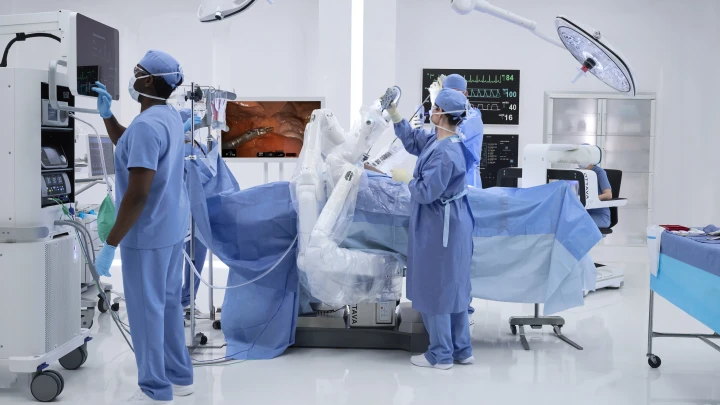
Modular Architecture: Unlike monolithic multi-arm carts, Versius features independent, portable robotic arms that clamp directly to standard operating tables or mobile bedside units with open 3D console ergonomics.
Market Challenger: The transaction positions Stryker directly against Intuitive Surgical's da Vinci 5 and Medtronic's Hugo in the multi-billion-dollar soft-tissue laparoscopic market.
The Signal: Stryker bypassed five years of internal R&D risk by acquiring commercial control over an already-cleared, modular multi-port robot. By pairing Versius's lower capital footprint with Stryker's massive hospital procurement relationships, the deal threatens Intuitive's stronghold in mid-tier community hospitals and outpatient surgery centers that cannot justify $2.5M monolithic consoles.

Credit: Scarlet.
London-based Scarlet raised a $50 million Series B led by Headline, with participation from Notion Capital, Atomico, Creandum, and Kindred Capital, expanding its automated certification platform for AI and software as a medical device (SaMD).
The details:
Triple Regulatory Authority: Scarlet holds official designations as an EU Notified Body under MDR, a UK MHRA conformity assessment body, and an FDA-recognized Third Party Review Organization (3P510k).
Queue Compression: Replaces manual, paper-heavy 12-to-18-month regulatory review queues with continuous automated testing against IEC 62304 and ISO 14971 standards.
Algorithmic Drift Telemetry: Enables healthtech developers to deploy continuous software updates and foundation model patches without triggering multi-month re-certification delays.
The Signal: With over 1,600 AI medical devices cleared by the FDA and hundreds of GenAI models entering clinical validation, regulatory approval has become the primary commercial bottleneck in digital health. Scarlet is turning compliance from an episodic consulting audit into continuous software infrastructure, capturing high-margin recurring revenue from digital health innovators globally.

Teal Health’s at-home screening kit includes the Teal Wand, a sample collection vial, and return packaging for laboratory HPV testing. Credit: Teal Health.
Boston-based .406 Ventures published its investment thesis detailing its lead in Teal Health's $22 million Series A, backing the FDA De Novo-authorized Teal Wand for at-home cervical cancer screening alongside Yosemite, Serena Ventures, and MPower Partners.
The details:
Clinical Parity: Pivotal 600-patient, 16-site clinical trial data demonstrated 96% diagnostic sensitivity for high-grade cervical pre-cancer (CIN2+), matching clinician-collected speculum samples.
Under-Screened Reach: Among the first 12,000 women screened with Teal, 59% were overdue for routine cervical screening due to discomfort, fear, or scheduling barriers.
Federal Policy Catalyst: HRSA preventive care guidelines require all ACA-compliant commercial health plans to cover at-home self-collected HPV screening at $0 patient cost-sharing beginning in 2027.
The Signal: Teal is executing the classic consumer-to-clinical bridge playbook: establish clinical equivalence through rigorous FDA trials, build direct-to-consumer adoption among alienated patients, and prepare for mandatory payer coverage under ACA preventive mandates. The 2027 rule will unlock massive commercial reimbursement for at-home self-collection.
QUICK HITS
Stryker's US ASC Bundling Strategy: How aggressively Stryker bundles Versius robotic consoles with its existing orthopedic implants, visualization towers, and power tools to undercut Intuitive's pricing in ambulatory surgery centers.
Scarlet's FDA 3P510k Review Volume: The velocity of generative AI diagnostic software clearances processed through Scarlet's accredited third-party review pathway over the next two quarters.
Commercial Payer Early Adoption of At-Home HPV: Whether major commercial payers (e.g. UnitedHealthcare, Elevance) contract with Teal Health in 2026 ahead of the mandatory 2027 ACA coverage deadline.
The deals:
CMR Surgical / Stryker: $400 Million strategic investment and exclusive US distribution agreement with buyout option for Versius multi-port robotic surgery.
Scarlet: $50 Million Series B led by Headline with Notion Capital to scale automated AI medical device certification across FDA, EU MDR, and MHRA.
Teal Health: $22 Million Series A led by .406 Ventures to commercialize the FDA-authorized Teal Wand at-home cervical cancer screening platform.
The pattern: Capital allocation in late October 2026 is aggressively converging on friction-elimination infrastructure across surgery, clinical AI regulation, and preventive diagnostics. Strategic medtech incumbents and venture funds are investing heavily in platforms that remove operational bottlenecks, whether by decentralizing robotic surgery into modular multi-arm carts (Stryker/CMR), compressing 18-month AI medical device regulatory queues into continuous software verification (Scarlet), or bypassing clinic speculum exams through FDA-authorized at-home diagnostic wands (Teal Health).
HLTH 2026 Global Convening | November 15-18, 2026 | Las Vegas, NV • The premier annual gathering of digital health leaders, payers, health systems, and healthtech investors.
ARPA-H SURPASS National Proposers Day | November 6, 2026 | Austin, TX & Virtual • Federal briefing on multi-million-dollar ARPA-H contracts for autonomous clinical trial platforms.
RSNA 2026 (Radiological Society of North America) | November 29 - December 3, 2026 | Chicago, IL • The world's largest medical imaging conference showcasing diagnostic AI and volumetric ultrasound.
CMR Versius Surgical Console: Portable robotic arms designed for laparoscopic soft-tissue procedures with open 3D ergonomics and low per-case consumable costs.
Scarlet Auto-Certify OS: Continuous compliance platform that automates technical documentation and algorithmic drift tracking for FDA 510(k) and EU MDR filings.
Teal Wand Diagnostic Kit: FDA De Novo-authorized self-collection wand achieving 96% clinical sensitivity for high-risk HPV detection without an in-clinic speculum.
CMR Surgical: UK-based surgical robotics unicorn providing modular, portable multi-port robotic systems ($400M Stryker partnership).
Scarlet: London-based regulatory automation platform accredited across EU MDR, UK MHRA, and US FDA ($50M Series B).
Teal Health: At-home women's health diagnostic platform expanding cervical cancer screening access via FDA-cleared self-collection ($22M Series A).
Modular Robotics in Soft-Tissue Surgery: The Strategic Logic of Stryker's $400M CMR Bet (Capital expenditure economics, ASC surgical suite adoption, and the multi-port monopoly disruption).
Automated AI Medical Device Certification: The Economics of Scarlet's $50M Regulatory Engine (FDA 3P510k, EU MDR notified body bottleneck, and continuous software surveillance).
The Consumer-to-Clinical Bridge in Women's Health: Teal Health and the 2027 Coverage Mandate (FDA De Novo clinical trial evidence, speculum displacement economics, and ACA $0 preventive reimbursement).
Which healthcare bottleneck represents the largest commercial opportunity for venture-backed innovation over the next 3 years? |
|
The common thread running through today's surgical robotics investments, automated AI regulatory engines, and at-home diagnostic wands is that healthcare innovation is no longer constrained by algorithmic capability alone. The actual frontier is clinical distribution and operational velocity.
When capital backs platforms that eliminate procedural friction for surgeons, regulatory delays for AI developers, and physical exam discomfort for patients, the entire healthcare ecosystem accelerates. Is your organization architected to remove structural friction, or are you still building for legacy clinical workflows?
How did we do today? |
See you tomorrow,
Dr. Dereck Mush, MD, MBA
The HealthTech Signal is independently funded. Sponsorships help us invest in better reporting, research, and a stronger newsletter for our readers. Want to reach HealthTech founders & executives while supporting the Signal? Get in touch.
Was this email forwarded to you? Sign up here.
Until tomorrow,
The HealthTech Signal

Dr. Dereck Mush, MD, MBA
Dr. Dereck Mush, MD, MBAKeep exploring