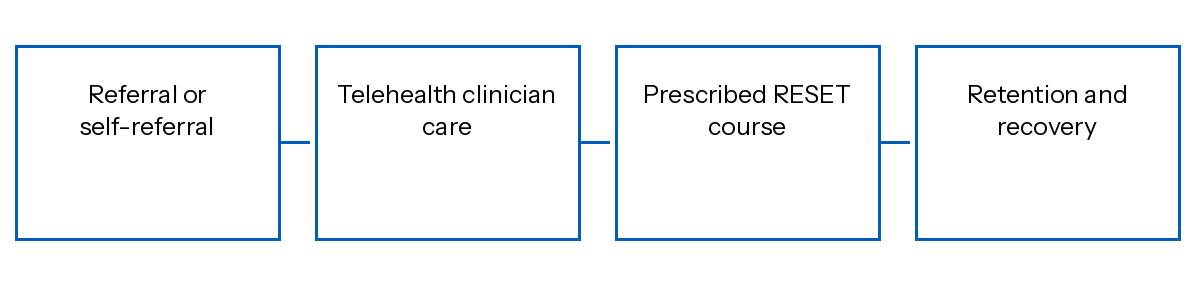
A patient begins outpatient opioid use disorder treatment with a buprenorphine prescription and a referral. Between appointments, RESET and RESET-O offer 12-week courses of cognitive behavioral therapy delivered on a phone alongside clinician care. They were among the first prescription apps FDA authorized to treat a disease.
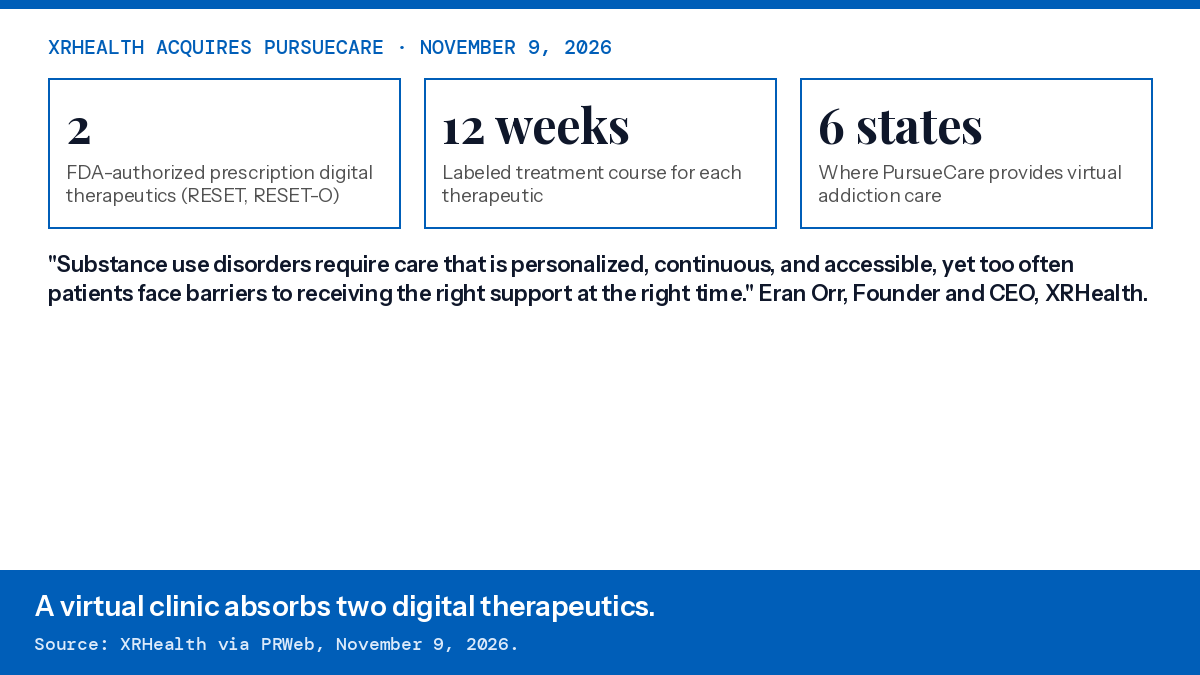
On November 9, XRHealth acquired PursueCare, bringing its virtual addiction care teams and prescription apps into a broader care delivery platform. We examine the assets, Medicare's payment framework and the opportunities created by combining prescribed software with clinician services.
Prescription digital therapeutics pair evidence-based software with clinician care. Bringing both into one organization aligns who prescribes, who furnishes the device and who receives payment.
In This Deep Dive
- Why this matters now
- What actually happened
- The obvious read versus the deeper signal
- Category map and taxonomy
- Evidence Ladder
- Regulation and payment: how Medicare pays for prescribed software
- Capital flows and bottom-up economics
- The HealthTech Investor's Signal
- Evidence boundaries
- Forward Intelligence
- The Bottom Line for Behavioral Health Operators and Digital Health Investors
Why this matters now
Substance use disorder treatment has a large access gap. XRHealth's release cites SAMHSA's national survey: in 2025, 44.6 million Americans aged 12 or older had a substance use disorder and 89% received no treatment. Retention is the other problem. Patients who start treatment often drop out, and treatment retention is one of the outcomes reSET-O was designed and cleared to improve.
Reimbursement changed recently. Starting January 1, 2025, Medicare began paying for digital mental health treatment devices through HCPCS codes G0552, G0553 and G0554 when a practitioner furnishes an FDA-authorized device classified under 21 CFR 882.5801 incident to ongoing behavioral health treatment. For 2026, CMS extended the same codes to ADHD digital therapy devices under 21 CFR 882.5803. RESET and RESET-O are classified under 882.5801. That is the first durable federal payment path for this product class, and it is built around a treating practitioner, not a software company.
The combination of a clinic and authorized apps offers a useful example of how care delivery and prescribed software can fit within one operating model.
Certainty: (A) SAMHSA figures as cited in XRHealth's release; (A) DMHT codes and classifications from CMS summaries; (C) commercial implications are our analysis.
What actually happened
- Announcement: November 9, 2026, via PR Newswire-PRWeb, datelined Boston.
- Buyer: XRHealth, which describes itself as a platform for therapeutic technologies spanning FDA-registered immersive devices, digital therapeutic programs, mobile care tools and peer support. It says it is licensed across 40 U.S. states and serves patients through Medicare Part B, VA programs and expanding commercial insurance.
- Target: PursueCare, a virtual provider of addiction treatment for alcohol, opioids, cannabis, kratom and 7-OH, with co-occurring mental health care, in Connecticut, Kentucky, Maine, New Hampshire, Ohio and West Virginia. It accepts private insurance, Medicare and Medicaid.
- Assets included: Multidisciplinary telehealth clinical services (clinicians, therapists, counselors, psychiatrists and case managers) and the prescription digital therapeutics RESET and RESET-O.
- RESET label: Prescription-only; delivers CBT alongside contingency management for adults in clinician-supervised outpatient treatment for substance use disorder; 12-week (90-day) course; not indicated where opioids are the primary substance or for patients on opioid replacement therapy.
- RESET-O label: Prescription-only; 12-week (84-day) course of CBT to increase retention in outpatient opioid use disorder treatment that includes transmucosal buprenorphine and contingency management.
- Terms: Not disclosed in the release.
- People: Eran Orr, founder and CEO of XRHealth; Nicholas Mercadante, founder and CEO of PursueCare. Both are quoted in the November 9 release.
- Stated plan: Combine PursueCare care teams and RESET products with XRHealth immersive VR support groups, where patients can participate as avatars, and extend care across AR and VR glasses, smartphones and smartwatches.
Certainty: (A) the acquisition facts come from the November 9 company release and product labeling summaries. Financial terms were not disclosed; no valuation is inferred.
The obvious read versus the deeper signal
The obvious read: a VR therapy company bought a small addiction telehealth provider to add services.
The deeper signal: the two FDA-authorized apps now sit inside an organization that delivers clinician care, holds multistate licensure and serves Medicare Part B patients. Medicare's DMHT codes pay the treating practitioner who furnishes an eligible device as part of a behavioral health plan of care. A provider that owns both the clinical service and the device can align those activities within one treatment program.
Certainty: (A) the asset list and Medicare billing structure; (B) the interpretation that ownership by a provider aligns with how DMHT payment works; (C) whether XRHealth can bill at scale, which no public data yet shows.
Historical playbook
Pear Therapeutics developed reSET, which received FDA De Novo authorization in 2017 (DEN160018), and reSET-O, cleared in December 2018 with evidence from a NIDA-sponsored trial of 170 patients. Sandoz initially led commercialization.
PursueCare announced in December 2023 that it had acquired reSET and reSET-O, alongside a $20 million Series B led by T.Rx Capital and Yamaha Motor Ventures. The products became part of a clinical provider's treatment offering.
The current XRHealth combination extends that care-delivery approach. The relevant continuity is the products' authorized treatment role, their use alongside clinicians and the provider infrastructure surrounding them.