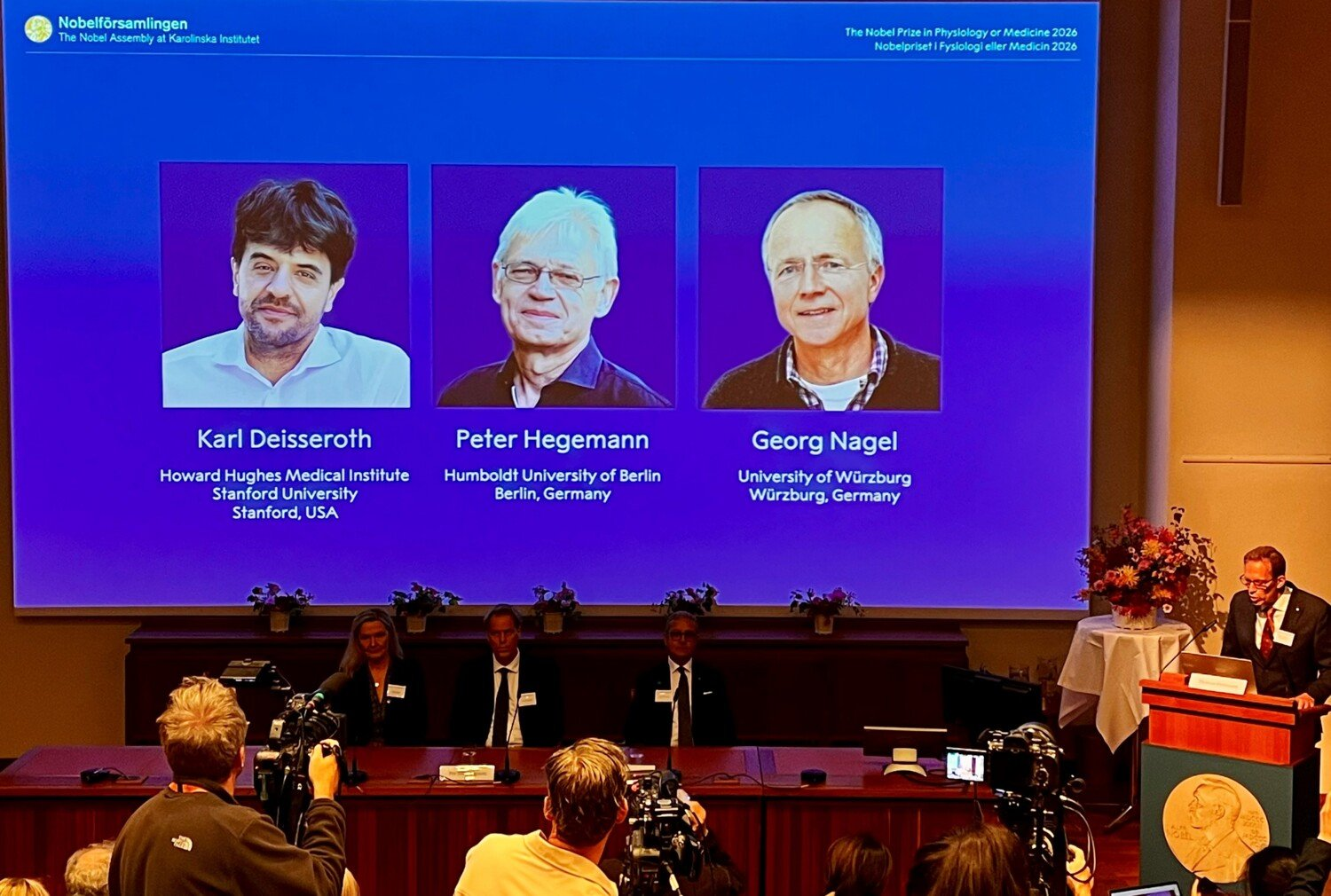
On Monday, the Nobel Assembly awarded the 2026 Nobel Prize in Physiology or Medicine to Peter Hegemann, Georg Nagel and Karl Deisseroth for discoveries leading to optogenetics. The starting point was a light-sensitive protein in a single-celled alga. The result was a way for researchers to switch selected nerve cells on or off with light and observe what happens in a living brain.
The distinction matters. Brain scans show where activity accompanies a thought or behavior; optogenetics lets scientists intervene in a defined circuit and test whether that activity helps cause it. That capability has changed basic neuroscience. It has also inspired experimental treatments, particularly for people with severe retinal degeneration. The Nobel honors a powerful research method, while clinical benefit still has to be established separately for each proposed therapy.
In This Deep Dive:
- Why this matters now: Moving from maps of the brain to tests of causation.
- What actually happened: The contributions of Hegemann, Nagel and Deisseroth.
- The obvious read versus the deeper signal: A research tool and its possible clinical path.
- Translational taxonomy: Established research use versus experimental human applications.
- The Evidence Ladder: From algal ion channels to meaningful patient outcomes.
- 📈 The HealthTech Investor's Signal: Where tools and therapeutic platforms create value.
- Counter-thesis: Gene delivery, light access, safety and functional endpoints.
- Forward intelligence: Four observable milestones.
- The bottom line for clinical researchers and healthtech investors.
Why this matters now
A scan may show a brain region becoming active when a person remembers, moves or feels fear. It cannot, by itself, establish which cells produced that response. Electrical stimulation can perturb tissue, but it often recruits multiple neighboring cell types and fibers. Optogenetics offers an experimental way to narrow the question: make a chosen population of cells responsive to light, illuminate it at a chosen time and measure the effect.
Researchers use that control to study neural circuits involved in movement, perception and behavior. The method's speed is crucial because neurons communicate on millisecond timescales. Its precision comes from combining a light-sensitive protein, a means of expressing it in selected cells and a controlled light source. Each component also becomes a hurdle when the aim shifts from studying an animal model to treating a person.
What actually happened
The Nobel Assembly's account, published by Karolinska Institutet, traces the work from Hegemann and Nagel's investigation of how the alga Chlamydomonas responds to light. They identified channelrhodopsin, a protein that opens an ion channel under blue light. Ion flow can alter a cell's electrical state. Crucially, the protein could make other cells light responsive as well.
Deisseroth and colleagues then brought that mechanism into neurons. Their 2005 work showed that blue light could trigger electrical signals in mammalian nerve cells; subsequent work extended the approach to the brains of living mice. The award recognizes the chain of discoveries that made precise, light-driven experiments on intact neural circuits possible. It does not mark the approval of an optogenetic drug or device.

Flasks of green single-celled algae on a laboratory bench. Image: The HealthTech Signal
The obvious read versus the deeper signal
The immediate headline is that three scientists received the medicine Nobel for controlling neurons with light. The more consequential shift is methodological: the field gained a way to test circuit-level hypotheses rather than relying only on correlations between brain activity and behavior.
That distinction can change how targets are selected. If altering a circuit in a model changes a relevant behavior, researchers have stronger grounds to investigate that circuit's role in disease. It is still a long step from a persuasive animal experiment to a treatment. A clinical product must reach the right human cells, deliver light safely, produce a useful effect and show that patients benefit in daily life.
🔒 HEALTHTECH SIGNAL PLUS · EXCLUSIVE SUBSCRIBER INTELLIGENCE