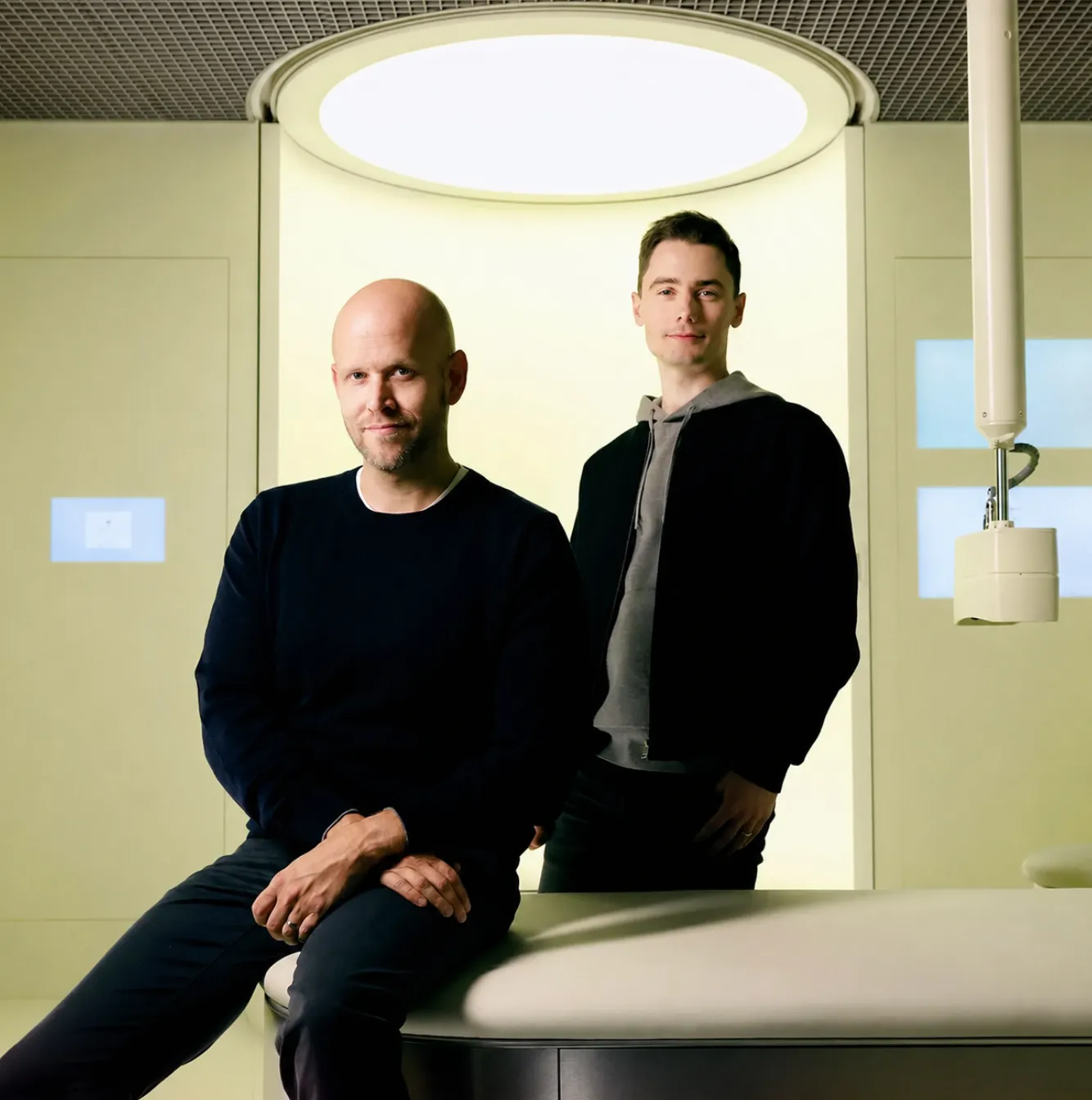
Spotify changed how we pay for music. Now Daniel Ek is trying to change how we pay for healthcare. At his startup, Neko Health, 80% of patients book and pay for next year's preventive scan before they even leave the clinic.
Think about that for a second.
These are healthy people. No symptoms. No diagnosis. Yet they are committing to another appointment twelve months in advance.
Healthcare has spent decades trying to convince people that prevention matters. Neko has built a model where people willingly pay for it. And the reason has almost nothing to do with the lasers.
The Technology Is the Least Interesting Part of the Story
The scan itself is genuinely impressive. You walk into a clinic, and in under an hour a mix of thermal cameras, 3D imaging, an ECG, lasers and finger sensors capture millions of data points across your heart, skin and blood. An AI builds the report. A doctor reads it back to you while you are still in the room. The UK scan costs £299.
Here is the part nobody wants to hear. The hardware is not the moat.
Competitors already exist. Prenuvo and Ezra run full-body MRI scans that can cost over $1,000. Better sensors get copied. Cheaper scans get built. If the machine were the whole company, Neko would be a gadget, not a $1.8 billion business.
So what did Ek actually build?
Healthcare Has Never Known How to Make Money From Healthy People
Call it the prevention paradox.
For decades, healthcare has been financially optimized for sickness, not health. The system pays when people become patients, not when they stay well.
That single reality has held prevention back more than any lack of technology.
Now, in 2026, the tide is turning. Governments and health systems worldwide are now pushing hard toward preventative care, partly to offset the soaring cost of chronic disease in ageing populations. The will is there. The business model never was.
There are fair critics, too. Some doctors warn that scanning healthy people risks overdiagnosis and the anxiety of chasing findings that were never going to hurt anyone. That debate is real and worth having. But notice what the debate is about. It is about the clinical trade-offs, not the economics. Regardless of where you land clinically, Neko has shown that prevention can become a repeatable business.
Neko did not invent prevention. It invented a way to get paid for it.
Ek Didn't Copy Apple. He Copied Spotify.
Ek likes to compare Neko to Apple, pointing to vertical integration and owning the full stack. That is the engineer's answer.
The marketer's answer is simpler. He ran the Spotify playbook.
Spotify's real genius was never the music. It was turning a one-off purchase into a recurring relationship you forget to question. Neko makes the same move at the perfect moment. The scan ends, your results are fresh, your attention is total, and that is exactly when they ask you to rebook.
Eighty percent say yes. A one-time checkup quietly becomes a subscription.
Ek put it plainly: "We're not selling a product, we're selling an experience."
That sentence is the whole strategy. Nobody prepays for a product. People prepay for a relationship with their own future self.
Your Moat Is Almost Never the Thing You Think It Is
If you are building anything in healthtech, here is the uncomfortable part.
You are probably in love with your technology. Your diagnostic. Your model. Your device. And your technology is almost certainly not your moat.
Neko's edge is not the scanner. It is the renewal rate and a waitlist of more than 100,000 people. Recurring revenue is what got valued at $1.8 billion, not the thermal cameras.
So the real question is not whether your tech is good enough. The question is this: at what exact moment do you ask for the money, and does your model make the customer say yes again next year?
If you are still selling one-off, you are leaving the entire company on the table.
The Best Technology in the World Still Loses to a Better Model
There is something very human underneath all of this. People do not fear scans. They fear finding out too late. Neko sells the opposite of that fear, and it sells it as a habit instead of a panic.
That is why this is Ek's second billion-dollar company, and why it probably will not be his last.
The lesson is not build a body scanner.
The lesson is that Ek did not out-engineer healthcare. He out-priced its assumptions.
If prevention finally has a working business model, who gets disrupted first: hospitals, insurers, or the annual physical itself?
Reply to the newsletter and tell me. I read every one.