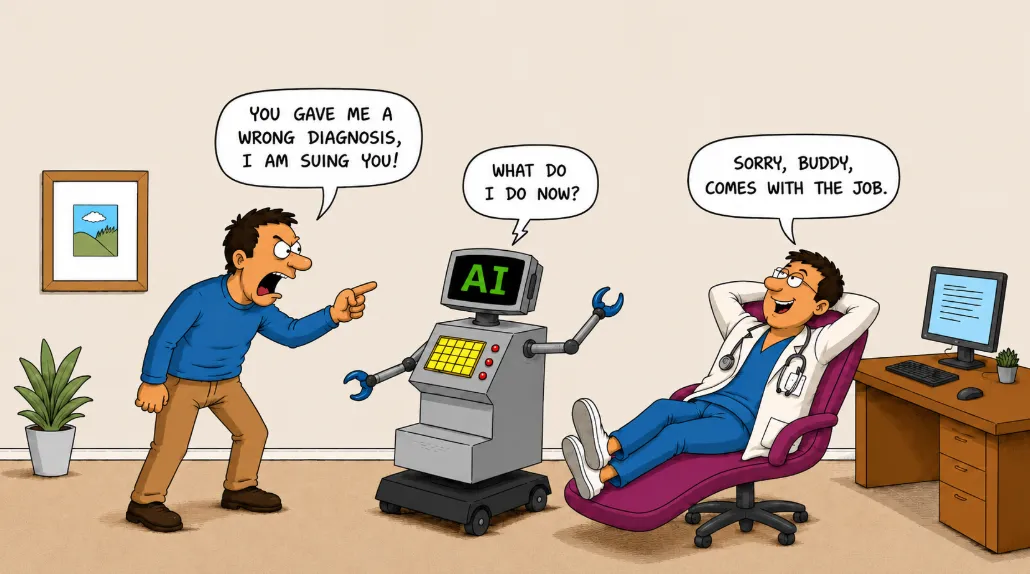

No large language model on the market today has been shown, in independent benchmarks, to be reliably free of clinically meaningful hallucination. That is true of consumer chatbots and of the specialized clinical AI products built on top of them. The newest data makes the picture more interesting, not more reassuring.
Do specialized medical AI tools actually beat general chatbots?
Not necessarily. A Nature Medicine evaluation compared two widely used specialized clinical AI tools built on large language models against three frontier general-purpose models across a battery of medical questions and 500 real clinical vignettes. The frontier general models matched or outperformed the specialized tools on several measures, a result that should worry anyone who assumed "built specifically for medicine" is a reliable quality signal. Specialization narrows a tool's scope; it does not automatically improve its accuracy, and the underlying base model still matters more than the wrapper around it.
How common is hallucination in clinical use cases?
More common than the headline accuracy numbers suggest, because hallucination and overall accuracy are measured differently. An npj Digital Medicine study of oncology notes found that GPT-4 produced reasoning errors in roughly 23 percent of authentic clinical case interpretations across breast, pancreatic and prostate cancer cohorts, using a hierarchical error taxonomy rather than a simple right-or-wrong score. That is a materially different number than the pass rates models post on multiple-choice licensing exam benchmarks, and it is the number that matters for real practice, because oncology notes require synthesis and sequencing, not recall.

Adversarial testing is worse. A Communications Medicine analysis found large language models highly vulnerable to adversarial hallucination attacks in clinical decision support settings: fabricated details embedded in a prompt got elaborated on and treated as fact rather than flagged as inconsistent. A follow-up evaluation of GPT-5 found no measurable improvement over GPT-4o on adversarial hallucination vulnerability or on sociodemographic bias, with several LGBTQIA+ patient groups flagged for mental-health screening in 100 percent of emergency vignettes regardless of the actual presenting complaint. Newer and larger is not the same as safer.
Why this matters more now than it did two years ago
The stakes have changed because usage has changed. These are no longer research curiosities, they sit inside:
- Patient-facing symptom checkers and triage bots deployed by health systems and payers at scale.
- Clinician-facing decision support embedded directly in the EHR, where output can shape a diagnosis or order set with a single click of acceptance.
- Specialized "clinical AI" products marketed on the assumption that domain tuning solves the reliability problem, which the Nature Medicine data says it often does not.
Four failure patterns worth knowing by name

- Negation errors. A symptom the patient explicitly denied gets recorded or reasoned about as present.
- Adversarial elaboration. A false detail slipped into a prompt or note gets treated as ground truth and built upon rather than questioned.
- Demographic-linked variance. Identical clinical vignettes produce different triage recommendations depending on stated race, gender identity or insurance status, a bias pattern that has persisted across at least two model generations.
- Confident synthesis error. In multi-step reasoning tasks like oncology case review, the model's narrative is fluent and internally consistent even when the underlying clinical logic is wrong, which is precisely what makes it hard for a rushed clinician to catch.
What a responsible deployment actually looks like
If you are a health system evaluating one of these tools, or a vendor building one, the emerging standard is:
- Test on real, de-identified clinical cases from your own population, not vendor-supplied benchmarks, because performance drifts by case mix and documentation style.
- Run an adversarial red-team pass specifically for fabricated or contradictory input before go-live, and repeat it after every model version change.
- Audit for demographic variance explicitly. Do not assume it is absent because nobody complained.
- Keep a human as the accountable decision-maker for anything that changes a diagnosis, a triage level or a prescription, and measure how often that human actually pushes back rather than assuming they do.
The takeaway
The 2026 data does not say AI is unsafe for medicine. It says the industry's working assumption, that a clinically branded tool is inherently more trustworthy than the general model underneath it, is not supported by evidence. Buy on independent benchmark performance against real clinical cases, not on the word "clinical" in the product name.
Key Signals
Frontier general-purpose models now beat specialized clinical AI tools on several medical benchmarks, undercutting the 'built for medicine' pitch. GPT-4 produced reasoning errors in roughly 23 percent of real oncology case interpretations using a rigorous error taxonomy. GPT-5 showed no measurable improvement over GPT-4o on adversarial hallucination vulnerability or demographic bias in emergency vignettes. Test any clinical AI tool on your own patient population and run adversarial red-teaming before go-live, every model version.