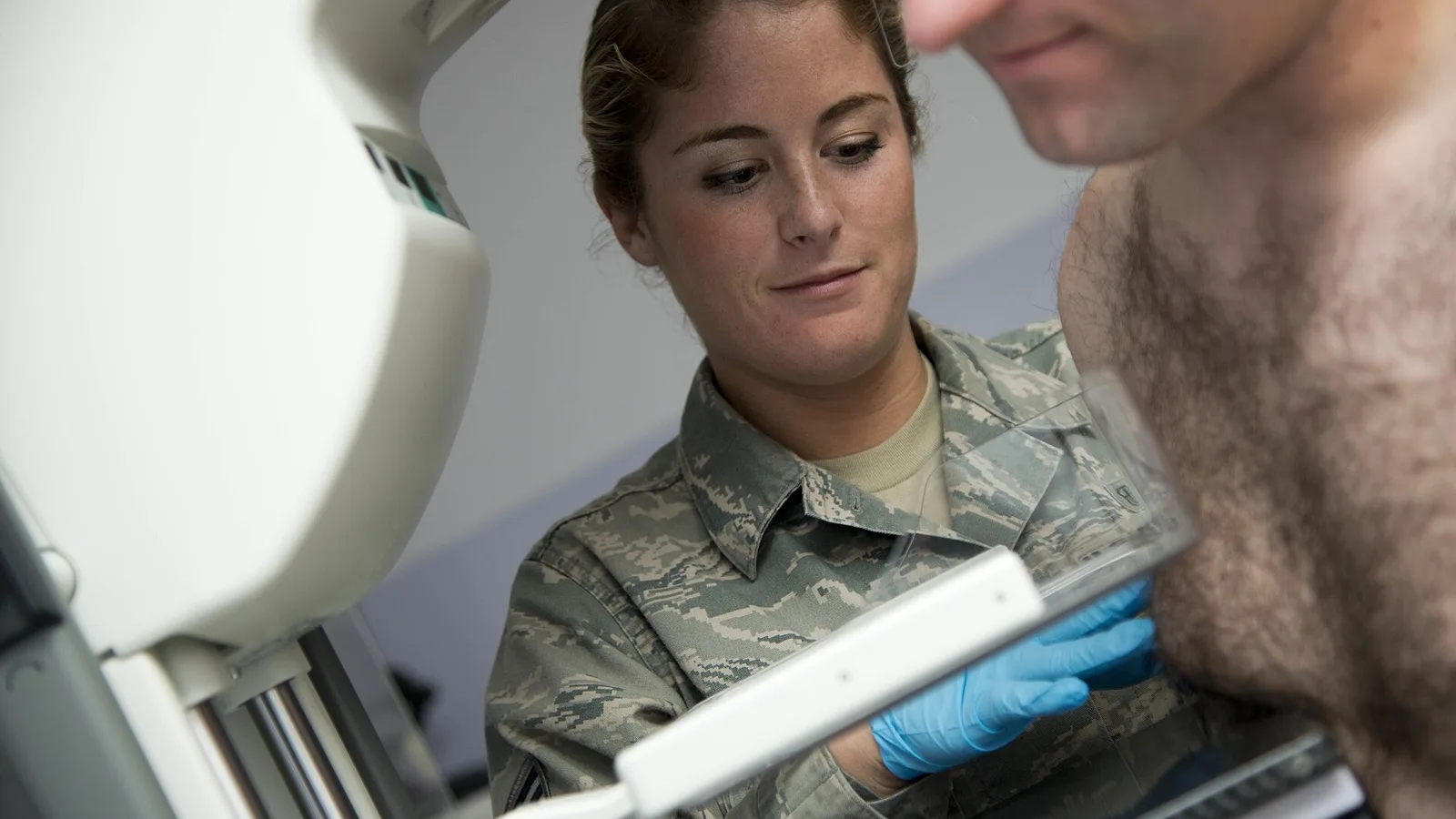
Breast screening has run on the same architecture for forty years: two radiologists read every mammogram, and a third adjudicates disagreement. The MASAI trial, run across Sweden and published in stages through 2025 and 2026 in The Lancet, is the first randomized, population-based study large enough to test whether an AI reading assistant can safely change that architecture. It matters because most prior AI mammography evidence came from retrospective reader studies, not prospective screening populations.
What was the MASAI trial design?
MASAI (Mammography Screening with Artificial Intelligence) randomized 105,934 women attending routine screening in Sweden to one of two arms: AI-supported screening, where a single radiologist read each mammogram with AI decision support, or standard care, where two radiologists read independently per usual double-reading practice. This is a non-inferiority, single-blinded, screening-accuracy trial, not a mortality trial, and that distinction drives everything that follows.
The primary endpoints were interval cancer rate (cancers found between screening rounds, the clearest signal a false-negative reading has occurred), cancer detection rate, and screen-reading workload.
What did the results actually show?
The published results, first in The Lancet Oncology and extended in The Lancet in early 2026, reported:
| Outcome | AI-supported arm | Standard double reading |
|---|---|---|
| Cancer detection rate | Higher, roughly 20 percent more cancers detected per screened population | Reference |
| Screen-reading workload | Reduced by roughly 44 percent | Reference |
| Interval cancer rate | Statistically similar between arms (non-inferior) | Reference |
| False positive recall rate | Similar or modestly lower in AI arm | Reference |
Source: MASAI trial, The Lancet 2025-2026, screening performance follow-up, PubMed, Lund University summary

The workload reduction is the number that will move budgets. Radiologist capacity is the binding constraint in most national screening programs, and a 44 percent reduction in reads, with detection either preserved or improved, is a genuinely large operational result if it replicates outside Sweden's relatively homogeneous screening population.
Does higher detection mean better outcomes?
Not automatically, and this is where I want readers to slow down. Cancer detection rate is not the same as mortality reduction. Finding more cancers can reflect two very different things: catching biologically significant cancers earlier, which saves lives, or detecting slow-growing, clinically indolent disease that would never have caused harm, which is overdiagnosis. Screening mammography has struggled with this distinction for decades, independent of AI.
MASAI was not statistically powered for breast cancer mortality, and the investigators have been explicit about that. Mortality follow-up, if it happens, will take a decade or more given how breast cancer natural history unfolds. Interval cancer rate is used as a proxy because a lower interval cancer rate has historically correlated with better long-term outcomes in screening research, but it is a proxy, not the endpoint itself.
What does this mean outside Sweden?
Three limits on generalizability matter for any health system reading this trial as a buying signal.
Population and equipment. The Swedish screening population is largely homogeneous in breast density distribution, imaging equipment vendor mix, and screening interval compared to the United States, where scanner heterogeneity and biennial rather than annual screening in some states change the operating point entirely.

Reader replacement, not reader augmentation. The AI arm replaced one of two human readers with the algorithm. That is a meaningfully different deployment model from AI as a triage layer or third reader, which is closer to how most US systems are piloting these tools. Performance under a different human-AI configuration is a different study.
Single-vendor result. MASAI tested one commercial AI system. The result does not transfer automatically to competing products, several of which have their own, generally smaller, retrospective validation sets.
What this does not prove
MASAI does not prove that AI-supported screening reduces breast cancer mortality. It does not prove the result generalizes to opportunistic (non-programmatic) screening common in the US. It does not prove long-term safety of replacing a second human reader across diverse populations, including women with dense breast tissue, who are both harder to screen and disproportionately affected by interval cancers. And it does not establish cost-effectiveness once integration, monitoring, and liability costs are included.
The takeaway
MASAI is the best prospective evidence to date that AI-supported single reading can match double reading on interval cancer rate while cutting radiologist workload nearly in half. That is a real, replicable-sounding operational result. It is not, yet, evidence that AI screening saves more lives. Health systems evaluating these tools should ask vendors for interval cancer data, not just detection rate, and should treat mortality benefit as an open question for the next decade of follow-up, not a settled fact from this trial.
Key Signals
105,934 women randomized: AI-supported single reading matched double reading on interval cancer rate. Screen-reading workload fell roughly 44 percent, the number that will actually move budgets. Cancer detection rose about 20 percent, but detection is not the same as proven mortality benefit. Single-vendor, single-country result: it does not yet generalize to US scanners or opportunistic screening.