This account draws on reporting by Citeline/Medtech Insight and the University of Utah's account of a related bionic arm program. The HealthTech Signal has not independently interviewed the trial participants.
For years, the most advanced mind-controlled prosthetic arms in the world have lived almost entirely inside research labs, wired into equipment that could not travel home with the patient. That changed at Shirley Ryan AbilityLab in Chicago, where researchers began the first home trial of a bionic arm using the e-OPRA implant, sending a patient home with a prosthetic system that has, until now, only been tested under controlled lab supervision.
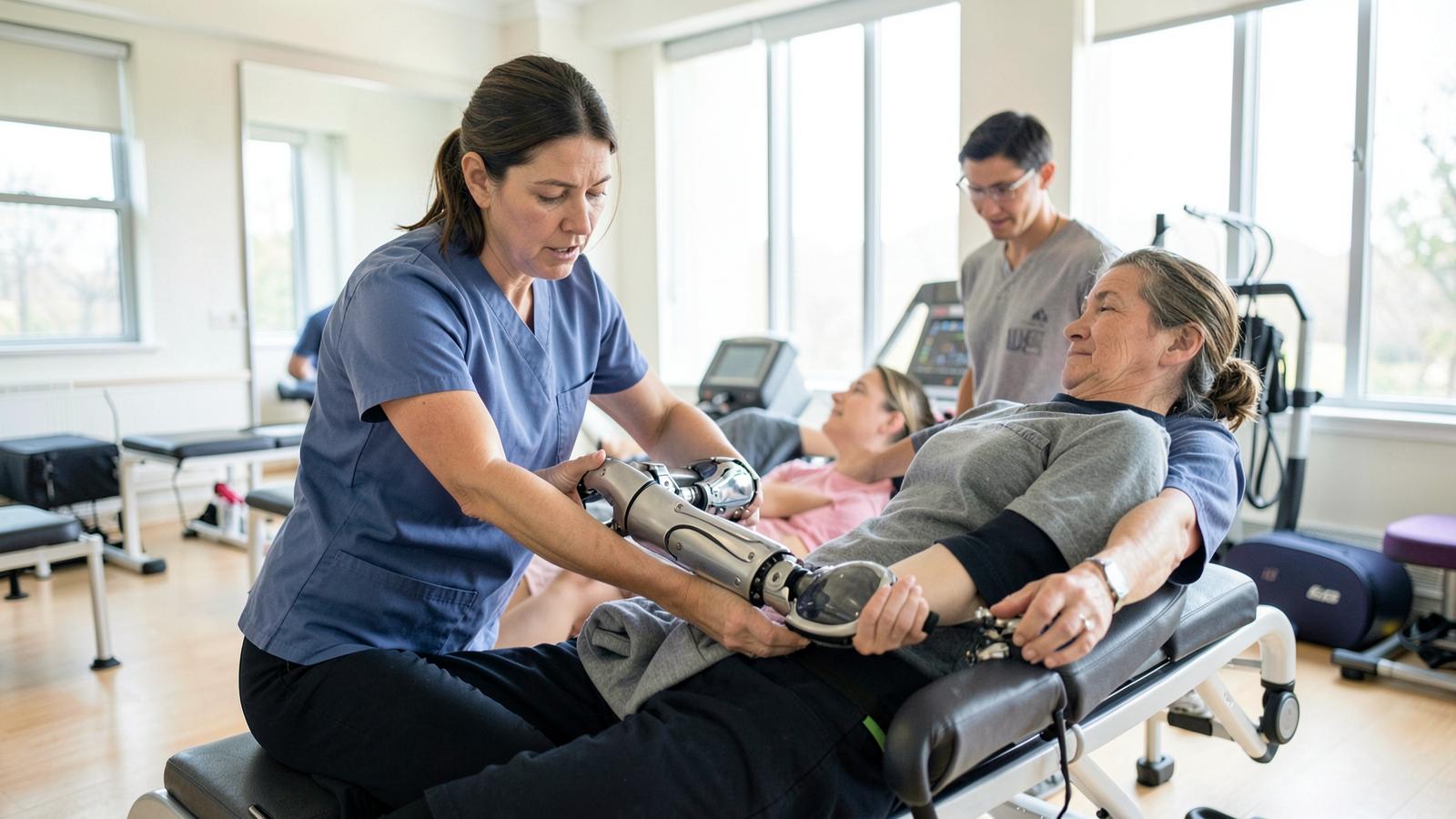
Dr. Levi Hargrove, the lead researcher on the study, described the ultimate goal as a prosthetic system that can control "any wrist, any elbow, any hand that a prosthetist" chooses to attach, built on a combination of technologies: the OPRA implant, a titanium fixture surgically anchored directly into the residual bone, targeted muscle reinnervation surgery, which rewires nerves that once controlled the missing limb into remaining muscle tissue, and EMG sensors that pick up the resulting electrical signals to drive the prosthetic's movements.
Why osseointegration changes the whole equation
Most prosthetic arms attach with a socket, a cup that fits over the residual limb and holds on through suction, straps or a liner. Sockets are the single most common source of complaint among prosthetic users: they shift during use, they cause skin breakdown and pressure sores, they feel unstable during anything beyond simple movement, and they have to be periodically refitted as the residual limb changes shape over time.
The OPRA system replaces the socket entirely. A titanium implant is surgically placed directly into the bone of the residual limb, and the prosthetic arm attaches to a connector that protrudes through the skin, similar in principle to how a dental implant anchors a replacement tooth directly into the jawbone rather than relying on a removable device. This is called osseointegration, and it produces a connection that moves as an extension of the skeleton itself rather than sitting loosely on top of soft tissue. Patients using earlier osseointegrated systems have reported dramatically improved comfort, stability and a sense that the prosthetic feels like part of the body rather than an external tool strapped on.
Combined with targeted muscle reinnervation, which gives the patient more distinct, controllable muscle signals to work with, and modern EMG sensing, which reads those signals to drive individual motorized joints, the resulting system allows for more intuitive, natural control than older cable-and-harness prosthetics that required deliberate, learned movements to trigger each function.
Why the home trial is the actual milestone, not the surgery
It would be easy to write this story around the surgical technology alone, but the more clinically significant development is the setting: a home trial. Every prior version of this kind of system has been validated primarily in a controlled lab, with engineers present to troubleshoot signal drift, recalibrate sensors, and manage the inevitable technical hiccups that come with a device this complex.
Real life does not offer that support. A prosthetic has to survive a patient reaching into a dishwasher, driving a car, showering, sleeping, and doing a hundred other unscripted daily tasks without an engineer standing by. Muscle signals drift over the course of a day as a person sweats, as reinnervated muscle fatigues differently than it does in a lab session, and as the skin around the implant site responds to the wear and tear of continuous daily use in ways a two-hour lab session simply cannot reveal. This home trial exists specifically to surface those failure modes, the ones that only show up when a device has to work reliably for weeks, not hours.

Where the broader bionic limb field actually stands
This Chicago trial sits alongside other active programs pushing similar frontiers. The University of Utah's LUKE Arm program has been testing its own thought-controlled prosthesis outside the lab in day-to-day use, and separate research published in Nature Medicine has demonstrated a hybrid neuroprosthetic system restoring both movement and sensation for a person with complete tetraplegia, a different but related frontier focused on restoring the sense of touch alongside motor control, sometimes called kinesthesia, which researchers increasingly view as essential to making a bionic limb feel genuinely usable rather than simply mechanically functional.
Taken together, these programs represent a field moving from "can we build a limb that responds to thought" toward "can we build one durable, comfortable and intuitive enough that a person wears it every day instead of leaving it in a drawer." That second question is harder, less photogenic, and far more important to the people who actually need these devices.
The systemic tension: who this reaches, and when
Every part of this system, the surgical implant, the targeted nerve reinnervation procedure, the custom EMG-driven prosthetic and its ongoing calibration and maintenance, requires a level of surgical and engineering specialization currently available at only a small number of research centers worldwide. None of it is close to being a standard offering at a typical prosthetics clinic, let alone something insurance would routinely cover outside a clinical trial.
The economics of upper limb loss make this urgent rather than academic. Amputees who abandon their prosthetics because a socket-based device is uncomfortable or unreliable are not a small population, and every year spent without a functional device has real costs in independence, employment and quality of life. A device this sophisticated is only a public health story once it moves from a handful of trial participants at Shirley Ryan AbilityLab to something a prosthetist in a mid-sized city can actually offer a patient, and that transition typically takes the better part of a decade after a successful early trial, contingent on FDA approval pathways and, eventually, a payer willing to cover a surgical implant plus a complex prosthetic system.
The takeaway
The engineering breakthrough here, an implant anchored in bone, nerves rewired for clearer signals, a hand that responds to intention rather than a harness, is genuinely remarkable. But the milestone that matters most in this story is the quieter one: researchers finally trusting the system enough to send it home with a patient, unsupervised, to find out if it survives an ordinary Tuesday. That is where prosthetic technology actually gets proven or exposed, and it is the test every future generation of bionic limbs will still have to pass.
Key Signals
Osseointegration, anchoring a prosthetic directly into bone rather than relying on a socket, addresses the most commonly cited source of prosthetic discomfort and abandonment. The home trial setting, not the surgical technology itself, is the more clinically significant milestone, since real-world use surfaces signal drift and durability problems a controlled lab session cannot reveal. The broader field is shifting from proving thought-controlled movement is possible toward proving a device is comfortable and reliable enough that patients wear it every day instead of leaving it in a drawer. Every component of this system currently requires specialized surgical and engineering expertise available at only a small number of research centers, meaning broader patient access remains years away and contingent on regulatory approval and payer coverage.