

Good morning, HealthTech insiders. Merck just gained a stronger case for bringing Winrevair into pulmonary arterial hypertension care sooner. The FDA added results from its HYPERION trial to the drug’s US label: among adults diagnosed within the past year who were already receiving background therapy, those given Winrevair had substantially fewer clinical worsening events than those given placebo. That is a meaningful update for a serious disease in which treatment decisions often cannot wait for symptoms to escalate.
There are two other moves worth your attention today. Heidi secured $340 million across an equity round and a separate growth investment to take clinical AI further into health system workflows. And Carvolix filed an FDA submission for the robotic component of its heart valve platform, moving it one regulatory step closer to a proposed US launch. The common thread is the work between a promising technology and routine care: evidence, integration, and a credible path to adoption.
In today's Signal:
Merck’s Winrevair label update: HYPERION data now appear in the US label after a trial in recently diagnosed PAH showed a 76% lower relative risk of clinical worsening when the drug was added to background treatment. What the result means for earlier use depends on individual patients and coverage decisions.
Heidi’s $340 million funding package: A $100 million Series C led by Blackbird values the company at $900 million; a separate $240 million growth investment led by General Catalyst’s Customer Value Fund supports expansion of its clinician tools.
Carvolix’s TAVIPILOT Robot submission: The company filed a 510(k) notification for its investigational robot. Its related AI guidance software received FDA clearance in 2025, but the robot still needs its own regulatory decision.
What we’re watching next: Coverage of earlier PAH treatment, the practical performance of clinical AI at scale, and whether robotic valve guidance can clear regulatory review and translate into routine cath lab use.
LATEST DEVELOPMENTS
CARDIOVASCULAR MEDICINE & REGULATORY INTELLIGENCE
1. FDA Adds HYPERION Data to Winrevair’s US Label for Recently Diagnosed PAH

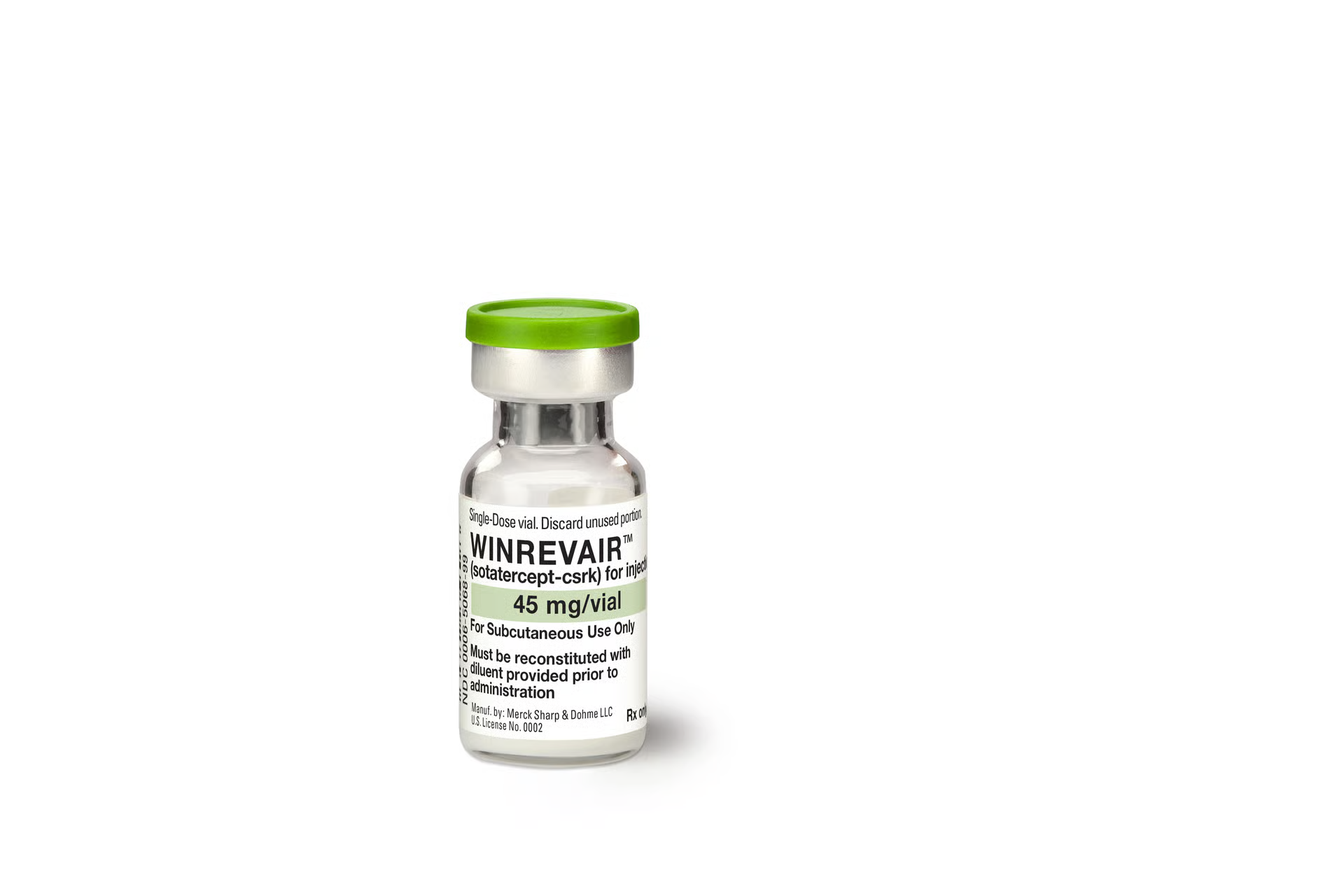
Winrevair (sotatercept-csrk). Image: Merck.
The FDA has approved an update to the US label for Merck’s Winrevair (sotatercept-csrk), incorporating evidence from adults with pulmonary arterial hypertension diagnosed within the preceding 12 months. Winrevair was already approved for adult PAH; this decision adds trial evidence about its use alongside background therapy earlier in the disease course.
The details:
The trial: HYPERION enrolled 320 adults with WHO functional class II or III PAH at intermediate or high risk of progression. Participants received Winrevair or placebo in addition to background treatment; the newly approved labeling reports the results in this recently diagnosed population.
The result: Clinical worsening occurred first in 17 of 160 patients receiving Winrevair and 59 of 160 receiving placebo. The hazard ratio was 0.24 (95% CI, 0.14-0.41; p<0.0001), representing a 76% reduction in relative risk over the study period, not a 76% absolute reduction or a demonstrated survival benefit on its own.
The clinical boundary: The findings support discussion of Winrevair earlier in PAH care, alongside existing treatment. They do not establish that vascular remodeling was reversed in patients or that all newly diagnosed patients should receive the drug; prescribers must weigh the labeled risks and individual circumstances.
The Signal: More substantial early-treatment evidence gives PAH teams another basis for treatment and coverage discussions. The next test is how specialist guidelines, prescribing decisions, and payer policies absorb the new label data in real practice.
CLINICAL AI & WORKFORCE AUTOMATION
2. Heidi Secures $340M Across Equity and Growth Investment for Clinical AI

Dr. Thomas Kelly, Heidi co-founder and CEO. Image: Heidi.
Heidi announced a $100 million Series C led by Blackbird, valuing the Melbourne-founded company at $900 million. Alongside that round, it secured a separate $240 million growth investment led by General Catalyst’s Customer Value Fund. The company says the new capital will support expansion from clinical documentation into supervised tasks around the patient visit.
The details:
Two financing components: The $100 million Series C is equity funding; Heidi describes the $240 million Customer Value Fund commitment as a growth investment for go-to-market capacity. Reporting both as a single $340 million equity round would misstate the deal’s structure.
Existing reach: Heidi says its tools now support about 2.8 million patient interactions each week across 190 countries and 110 languages. These company-reported usage figures indicate scale, though they are not independent proof of clinical quality, retention, or cost savings for every customer.
Beyond documentation: Heidi already offers an ambient scribe, a clinical reference product called Evidence, a dedicated audio capture device called Remote, and Dictate. Its announcement says further supervised agent capabilities will require clinical evidence, quality systems, and, where appropriate, regulatory submissions; the proposed capabilities are not yet available in the UK and EU.
The Signal: Investors are backing tools that can fit into established care settings and expand beyond note creation. For buyers, the practical questions remain straightforward: Does the system save clinicians time, meet local safety requirements, and work inside the actual care workflow?
STRUCTURAL HEART & SURGICAL TECHNOLOGY
3. Carvolix Submits TAVIPILOT Robot for FDA 510(k) Review

TAVIPILOT Robot is under FDA review. Graphic: Carvolix.
Carvolix has filed a 510(k) premarket notification for the TAVIPILOT Robot, intended to work with its existing image guidance software during transcatheter aortic valve replacement. The September 22 filing is a regulatory milestone, not FDA clearance of the robot.
The details:
What is already cleared: TAVIPILOT Software received FDA 510(k) clearance in July 2025. It provides real-time image guidance during valve implantation; that authorization does not extend automatically to the separate robotic component.
What the filing covers: The investigational robot is designed to assist with catheter stability and controlled positioning under an operator’s supervision. Carvolix says its submission draws on its ROTAO1 first-in-human study, with successful use in 10 of 10 procedures, and an ongoing study of the combined platform. Those early results do not establish comparative clinical benefit.
What comes next: Carvolix is targeting a US launch of the integrated platform in early 2027 if the FDA clears the robot. The company says a €10 million tranche of an existing structured debt facility is conditional on that clearance, adding a financing consequence to the regulatory decision.
The Signal: A cleared software component and a robot under review create a concrete test of the integrated-platform thesis. Regulatory clearance, if granted, would still leave hospitals to assess training, workflow fit, costs, and whether the system improves procedural outcomes.
QUICK HITS
👀 WHAT WE'RE WATCHING NEXT
1. PAH coverage decisions: Will commercial and public plans update their Winrevair policies in light of HYPERION’s earlier-treatment data? The label update supplies evidence, but it does not itself change a plan’s authorization criteria or eliminate the need to monitor safety.
2. Ambient AI inside health systems: Heidi’s newly announced funding gives it room to pursue larger deployments. We will watch for independently measured effects on documentation time, clinician review burden, and patient safety as the company expands its supervised capabilities.
3. Two different oncology timelines: The FDA approved GSK/Nuvalent’s ROS1 inhibitor Jideytro on July 22, not September 22. Its approval remains relevant background for the accompanying oncology deep dive; the next separate regulatory date to monitor is the reported November 27 FDA target date for investigational ALK inhibitor neladalkib.
💰 FOLLOW THE MONEY
The deals:
Heidi: $100 million Series C led by Blackbird at a $900 million valuation, plus a separate $240 million growth investment led by General Catalyst’s Customer Value Fund for expansion. The second component should not be described as another $240 million of equity.
Teal Health: $22 million Series A led by .406 Ventures, bringing its reported total funding to $45 million. The company plans to expand partnerships around the FDA-authorized Teal Wand, a device for at-home HPV sample collection followed by laboratory testing and clinical follow-up.
The pattern: These financings support different kinds of access infrastructure: Heidi aims to reduce work around clinical visits, while Teal aims to make preventive screening easier to obtain. Funding is a measure of investor conviction, not a substitute for demonstrated outcomes or a guarantee of broad reimbursement.
📆 UPCOMING HEALTHTECH EVENTS
Frontiers Health 2026: October 20-21, 2026 | Berlin, Germany. A European gathering for digital health companies, health systems, and investors discussing adoption, evidence, and market access.
HLTH USA 2026: November 15-18, 2026 | Las Vegas, NV. Healthcare leaders, founders, payers, and investors convene to discuss technology, care delivery, and business models.
RSNA 2026: November 29-December 3, 2026 | Chicago, IL. Radiology’s annual scientific assembly, with imaging research, clinical practice, and technology demonstrations.
🛠️ Trending HealthTech AI Tools
Heidi Evidence: A clinical reference feature that helps clinicians look up information with cited sources alongside Heidi’s documentation workflow; users still need to assess relevance for each patient.
TAVIPILOT Software: FDA-cleared AI-assisted image guidance for tracking anatomical and valve landmarks during transcatheter aortic valve procedures. Its separate robot remains investigational.
Cortechs.ai NeuroQuant PET: Automated quantification for amyloid PET, including Centiloid scores. Check the product’s labeled indications: some additional outputs on the company’s page are designated research use only.
🛠️ Trending HealthTech AI Startups
Heidi: Melbourne-founded clinical AI company growing from ambient notes into clinician-supervised tasks and evidence lookup after its newly announced financing.
Teal Health: San Francisco women’s health company led by co-founder and CEO Kara Egan. Its FDA-authorized Wand collects an at-home specimen for lab-based HPV screening; it does not diagnose cancer by itself.
Carvolix: Publicly listed French medical technology company developing an integrated valve guidance and robotic platform. Its software is cleared in the US; its robot is under FDA review.
DECISION INTELLIGENCE
Highlights: Deep Dives & Industry Reports
Upfront Disease Modification: How Winrevair’s HYPERION Label Update Changes the PAH Treatment Discussion: A closer look at the trial’s earlier-treatment population, its clinical-worsening endpoint, and the open questions around access and long-term outcomes.
The $340M Ambient AI Funding Shift: What Heidi’s Financing Says About Clinical Workflows: Why the distinction between a $100 million equity round and a separate $240 million growth investment matters when assessing expansion claims and operating economics.
Overcoming ROS1 Resistance: The Evidence Behind Jideytro and GSK’s Nuvalent Acquisition: Background analysis of a July 22 FDA approval, its 44% overall response rate in a previously treated single-arm study, and the limitations of projecting commercial success from that result.
Which hurdle matters most when moving a promising health technology into routine care? |
That's it for today!
Winrevair’s new label evidence puts earlier PAH treatment back in focus. Heidi has fresh capital to take on more of clinicians’ daily work. Carvolix has reached the next checkpoint for an integrated valve platform, with a regulatory decision still ahead.
Each story now has an important next question: whether the trial data change access, whether AI helps in real care settings, and whether a robot under review can prove useful in the cath lab. Which of those gaps between a promising announcement and everyday care will close first?
How did we do today? |
See you tomorrow,
Dr. Dereck Mush, MD, MBA
The HealthTech Signal is independently funded. Sponsorships help us invest in better reporting, research, and a stronger newsletter for our readers. Want to reach HealthTech founders & executives while supporting the Signal? Get in touch.
Was this email forwarded to you? Sign up here.
Until tomorrow,
The HealthTech Signal
Related reading


Upfront Disease Modification: How Winrevair's HYPERION Label Update Rewrites Pulmonary Vascular Care

Risk-stratified PSA screening is bringing a once-abandoned test back into primary care

Telehealth testosterone care is scaling faster than the guidelines that govern it
Keep exploring