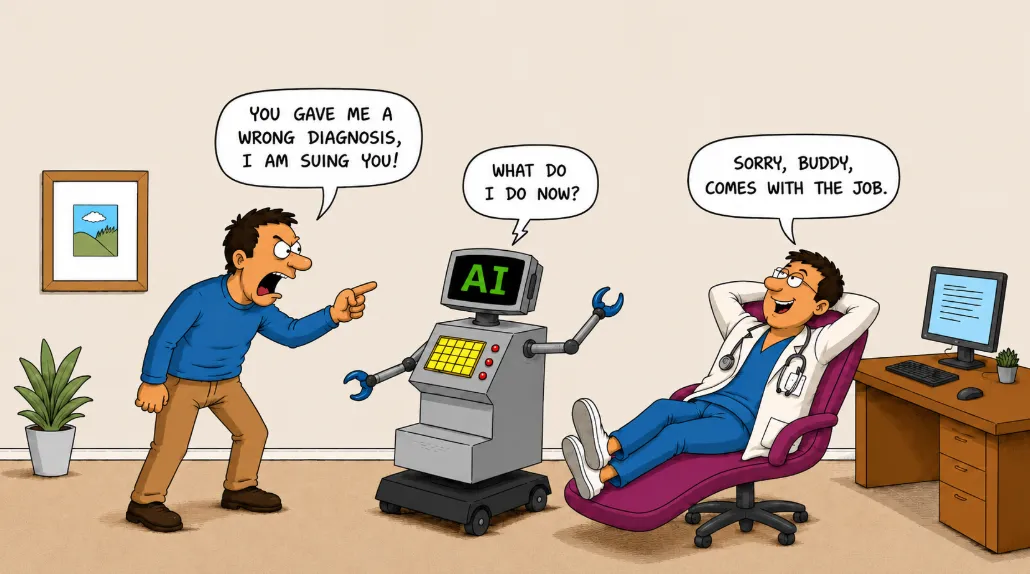
AI has not reduced prior authorization denials. In most markets it has made them faster and, by several measures, more frequent. That is the uncomfortable finding sitting underneath a year of state legislation and a Health Affairs analysis of what the authors call an "AI arms race" between insurers automating denials and providers automating appeals.
Is AI actually denying more health insurance claims?
The honest answer is that nobody outside the payer has the full denominator, which is itself the story. KFF's analysis of newly disclosed prior authorization metrics found denial rates varying enormously across insurers even within the same state and product line, a spread that is hard to explain by clinical variation alone and easy to explain by which plans have handed first-pass review to a model tuned for throughput.
What is documented: nearly seven in ten insured adults describe prior authorization as burdensome, and insurers have adopted large-language-model and rules-based systems on both the front end of utilization review and the back end of claims adjudication. The tools are marketed to reduce administrative cost. The Health Affairs review is blunt about the risk: an algorithm sitting inside utilization review can supercharge existing flaws in coverage policy rather than correct them, because it applies the same restrictive logic at far higher volume with far less time for a human reviewer to catch an error before it becomes a denial letter.
Why the "human in the loop" often is not one

Every payer will tell you a licensed clinician makes the final call. The practical question is how many seconds that clinician spends per case. When a model pre-screens thousands of requests and flags a subset for denial, the human reviewer is reviewing the model's recommendation, not the chart. That is a fundamentally different cognitive task than independent judgment, and it is the exact automation-bias pattern documented in clinical decision support research: reviewers tend to defer to a system that is right most of the time, which means the ones it gets wrong pass through with less scrutiny, not more.
What regulators did about it in 2026
Federal action has been narrow. CMS finalized rules requiring faster electronic prior authorization turnaround and more transparency on decision timeframes, but did not ban algorithmic decision-making outright.
State action has been aggressive, and bipartisan. KFF Health News reported that red and blue states alike have pursued laws requiring:
- A licensed physician, not an algorithm alone, to issue any adverse determination involving medical necessity.
- Disclosure to patients and providers when AI was used in a coverage decision.
- Audit rights allowing regulators to review the training data and validation of utilization-review algorithms.
- Turnaround-time caps that are difficult to hit if every case still routes to a slow human, which is forcing insurers to be transparent about where the model's decision is actually final.
The friction point in 2026 has been federal preemption. The administration's posture has favored a lighter national AI framework that would limit how far state insurance regulators can go, setting up a fight that KFF Health News frames as unusually cross-partisan on the state side.

What providers are doing in response
Health systems are not waiting for regulation. Provider-side vendors are now selling AI appeal generation, drafting clinical justification letters and pulling supporting literature automatically in response to a denial. That is the "arms race" framing: AI denies, AI appeals, and the deciding factor in an individual patient's care becomes which side's model is better resourced, not which side is clinically correct.
What this means for founders and health system leaders
- If you sell utilization-review software to payers, transparency is now a product requirement, not a compliance afterthought. Build the audit trail and the plain-language denial rationale in from day one; retrofitting it after a state investigation is far more expensive.
- If you sell appeal automation to providers, the evidence bar is your differentiator. A denial letter overturned on appeal is a data point insurers already track by vendor; publish yours.
- If you run a health system, treat the payer's AI adoption as a contracting issue. Ask for denial-rate and overturn-rate data by algorithm version, not just by plan, in every renewal negotiation.
- If you are a patient-facing startup, "we help you appeal denials" is now a real category with real demand, not a niche. The KFF and Health Affairs data both point to volume, not edge cases.
The takeaway
AI in prior authorization is not a story about a rogue algorithm. It is a story about incentives: a system optimized for denial-processing speed will produce more denials unless someone builds accountability into the loop deliberately. That accountability is now being legislated state by state, unevenly, while the underlying technology keeps shipping. Whoever builds the transparent version before it is mandated will not need a lobbyist to defend the product.
Key Signals
Denial rates vary wildly across insurers even within the same state, a spread hard to explain by clinical variation alone. States red and blue are moving to require a licensed physician, not an algorithm, to issue adverse coverage determinations. Provider-side AI appeal tools are now matching payer-side AI denial tools, turning coverage into an algorithmic arms race. Ask every payer for denial and overturn rates by algorithm version at your next contract renewal, not just by plan.