
Listen instead
In a busy examination cubicle at Leeds General Infirmary, a doctor sits face-to-face with a patient, holding uninterrupted eye contact instead of turning away to type on a keyboard. A small, discrete microphone on the desk captures their conversation. Within minutes, the dialogue is converted into a structured clinical note, ready for review. This is the practical execution of ambient clinical voice technology, which was recently tested in one of the high-volume emergency care environments in the United Kingdom.
Leeds Teaching Hospitals NHS Trust has completed a pilot of the TORTUS ambient voice assistant within its ambulatory emergency department. The trial demonstrates a shift in how acute care clinicians allocate their time. By capturing spoken clinical interactions, the system automates the creation of medical documentation, allowing physicians to focus on diagnostic reasoning and direct patient engagement. Following the pilot, the trust is preparing to expand the technology across its broader emergency care infrastructure.
Measuring the documentation relief The pilot program ran from February to April at Leeds General Infirmary, a major trauma center that manages high patient volumes. During this eight-week period, the trust evaluated the impact of the ambient voice tool on clinical workflows, tracking time allocation and documentation accuracy.
The data gathered during the trial indicates that the technology reduced clinical documentation time by 61 percent. This reduction represents an average saving of 13 minutes during each patient consultation. In an emergency department where clinician time is the primary constraint, saving 13 minutes per encounter is operationally meaningful. Over a standard 10-hour shift with 15 patient interactions, a single clinician can reclaim more than three hours of time previously spent on administrative data entry. This reclaimed time can be redirected toward clinical decision-making, physical examinations, and direct communication, mitigating the administrative fatigue that frequently contributes to workforce burnout.
Beyond time efficiency, the evaluation assessed clinical safety. The trust reported high precision in capturing medication names, dosages, and allergy profiles. These elements represent high-risk areas in emergency admissions, where errors in drug reconciliation can lead to adverse patient outcomes. To mitigate these risks, the software requires explicit clinician review and validation before any generated note is saved to the electronic patient record. The clinician remains the final clinical authority and must manually approve or edit the text.
To address data privacy requirements, the system architecture operates on a minimal data retention model. The audio recordings and temporary transcriptions are deleted from the local device and cloud servers once the clinician finalizes the note. This design addresses NHS information governance standards and patient privacy concerns regarding the storage of voice data.
The challenges of clinical scaling Following the pilot, Leeds Teaching Hospitals NHS Trust plans a phased rollout across its emergency care departments. The expansion will transition the technology from the ambulatory emergency unit into majors, minors, paediatrics, and emergency nursing workflows.
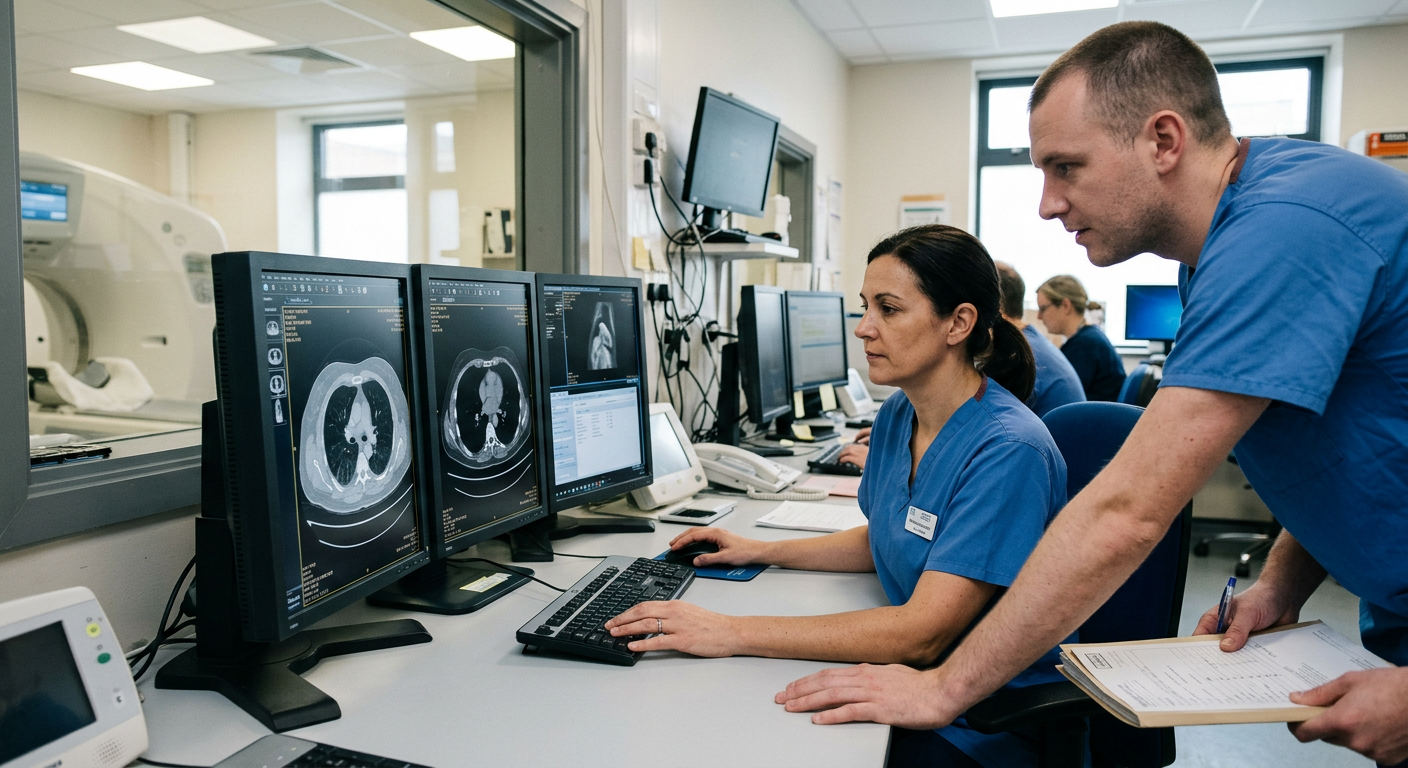
Scaling ambient documentation from a structured ambulatory clinic to more chaotic emergency environments presents distinct technical and operational challenges. Ambulatory clinics typically feature quiet, one-on-one consultations. In contrast, the majors and paediatrics departments are characterized by high ambient noise, multiple medical staff speaking simultaneously, and frequent interruptions from alarms and equipment.
For the technology to succeed in these noisier settings, the acoustic models must distinguish between the voices of different clinicians, patients, and family members. This process, known as speaker diarization, is critical in paediatric care, where a parent often provides the history on behalf of a child. Additionally, emergency nurses document different clinical parameters than physicians, focusing on rapid assessments, triage scores, and nursing interventions. The underlying software must therefore adapt to different structural templates and clinical vocabularies to support nursing workflows without adding steps to their existing processes.
Regulatory frameworks and trust The technology used in the Leeds pilot, developed by TORTUS, obtained UKCA Class IIa medical device certification. This certification represents a critical regulatory distinction in the UK digital health market, where many administrative transcription tools operate without clinical-grade validation.

Class IIa certification under UK medical device regulations means the software has undergone third-party assessment regarding its clinical safety, data processing integrity, and diagnostic safety. The company was co-founded by Dr Dom Pimenta, a former NHS cardiologist who serves as chief executive officer. His clinical background appears to have influenced the platform's design, particularly the inclusion of hard safety stops and the integration of standardized NHS medical vocabularies.
For hospital trust executives and chief information officers, this deployment provides empirical evidence of utility in an acute care setting. While ambient voice tools have seen adoption in primary care and outpatient clinics, their use in high-acuity emergency departments has been limited. The quantitative finding of a 61 percent reduction in documentation time within an active NHS emergency department provides hospital administrators with the operational data required to build business cases for wider clinical AI procurement.
Source: The HealthTech Signal




