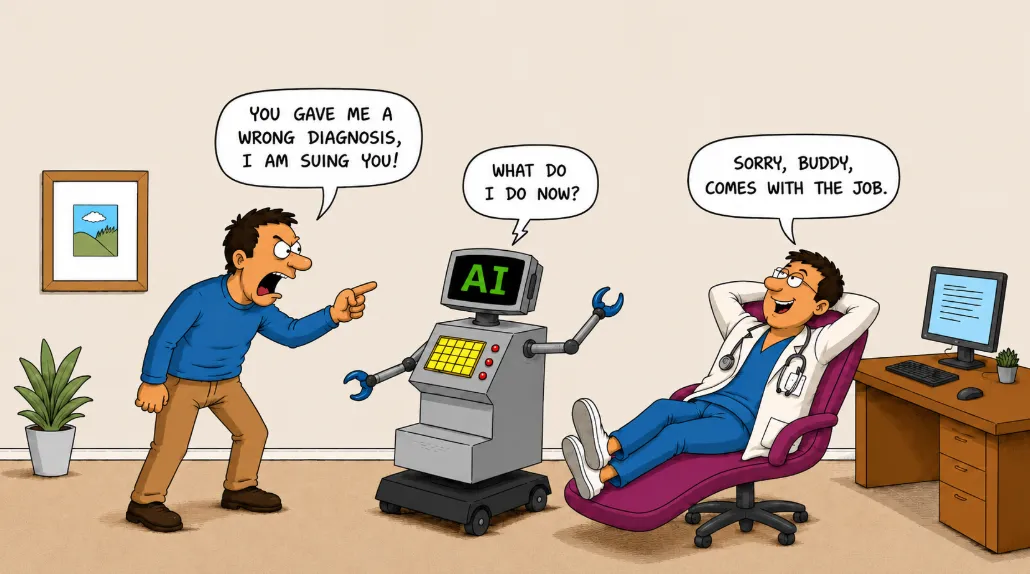
Good morning, HealthTech insiders. The NHS patient watchdog reported yesterday that AI scribes are getting drug names and diagnoses wrong across NHS England, and in most cases, it's the patients catching the errors, not the clinicians. In one case, a woman was told her MRI showed demyelination, the nerve damage linked to multiple sclerosis. One missing word: the result had said "null demyelination." The AI dropped it. She happened to be an NHS professional herself. She checked. Most patients don't.

Today's issue connects three stories that look unrelated but aren't. An AI tool adopted at speed and without regulation is failing in silence. A tool built with rigorous validation just caught 46% more sepsis cases and triggered 10 times fewer false alarms. And the person who takes over Apple today built the Apple Watch and the AirPods-as-hearing-aids. The thread running through all three: clinical AI's accountability gap isn't closing on its own, but the examples of what accountability actually looks like are getting harder to ignore.

CLINICAL AI

In today's Signal:

  • Healthwatch England: 27 AI scribes recording wrong drug names and diagnoses across NHS England, none classified as medical devices

  • Bayesian Health's FDA-cleared sepsis AI finds 46% more cases and fires 10x fewer false alarms, Suchi Saria makes TIME100 AI 2026

  • John Ternus becomes Apple's CEO today, the hardware engineer who built the Apple Watch now owns the company's health strategy

  • Follow the money: a quiet funding Monday, but the past week's capital pattern still points one direction

  • Quick Hits: Suki launches verbatim AI dictation inside Epic; Sword and Headspace two weeks from closing 

LATEST DEVELOPMENTS

CLINICAL AI
1. NHS scribes are misrecording drug names and diagnoses. Patients are the ones catching it.

Source: The Guardian / Stephen Barnes, Medical/Alamy — An NHS consultation, as concerns grow over AI scribes producing errors in drug names and diagnoses.

The signal: Healthwatch England, the statutory patient watchdog, published a warning yesterday that AI scribes are introducing drug and diagnosis errors into NHS records, and the last line of defence is whoever happens to read their letter carefully.

The details:

  • Twenty-seven different AI scribes are in use across NHS England. Not one is classified as a medical device, which means no England-wide regulator has tested them for safety before deployment.

  • Documented errors: a scribe dropped 'null' from 'null demyelination,' turning a clear MRI result into a flag for nerve damage linked to MS. Another swapped the prescribed drug for one with a similar name. A third hallucinated that a patient was told to 'continue their Prozac', a drug never discussed in the consultation.

  • The MHRA ruled that scribes used only for transcription are not medical devices. That definition creates an obvious incentive: label your product as a transcriber, skip the regulation. Dr. Shier Ziser Dawood, a London GP, noted that reviewing every AI transcript to catch errors means the tools are not, in practice, saving time.

Why it matters: These are not edge cases. They are structural failures in how a category was allowed to spread. Twenty-seven products, no device classification, no England-wide standard, and the check the whole system depends on is whether the patient reads their letter. That is not a safety framework. It is a prayer.

BIG TECH
2. Apple's new CEO built the Watch and the AirPods. Now he owns the health strategy too.

The signal: John Ternus formally becomes Apple's CEO today, replacing Tim Cook, who moves to Executive Chairman. Ternus built the hardware Apple's health story runs on: the Apple Watch, AirPods as over-the-counter hearing aids, and every health-sensing device the company ships.

The details:

  • Ternus has been Apple's SVP of Hardware Engineering for years. Cook was an operations and supply-chain CEO; Ternus is a product and engineering one. Apple is returning the top job to a technical product leader for the first time since Steve Jobs.

  • His first major product cycle: iPhone 18 Pro and Apple's first foldable device. A rebuilt Siri, this time using Google Gemini as its foundation, is set for a full deployment this month.

  • On-device AI is Ternus's stated strategic advantage over cloud-dependent rivals. For health specifically, that means continuous, private, AI-processed sensor data from the wrist, ears, and eventually other surfaces, without a hospital in the loop.

Why it matters: The health implications are not about a single feature. They are about who controls the layer between patients and their data when they are not in a clinical setting. Ternus built that layer. He now runs the company that owns it.

Operator's move: If you build products that live between patients and the healthcare system at home, the new Apple leadership is worth watching closely. Ternus's hardware-first instinct tends to produce tight vertical integration, which is either a platform opportunity or a competitive enclosure, depending on where you sit.

CLINICAL AI
3. A sepsis AI catches 46% more cases and fires 10x fewer alarms. This is what 'validated' looks like.

Source: Bayesian Health / CityBiz, August 31, 2026 — Dr. Suchi Saria, Johns Hopkins computer scientist and founder of Bayesian Health

The signal: Dr. Suchi Saria, Johns Hopkins computer scientist and founder of Bayesian Health, made TIME's 2026 AI 100 list on August 31. The recognition follows Bayesian Health's FDA clearance in May for its continuous AI sepsis monitoring system. Early Cleveland Clinic data: 46% more sepsis cases identified, 10 times fewer false alerts, seven times as many warnings before antibiotics were started.

The details:

  • Sepsis contributes to more than one-third of hospital deaths in the US, per the CDC. The core problem with warning systems is alert fatigue: too many false alarms, and clinicians stop responding quickly to the real ones.

  • Bayesian Health's system continuously analyzes clinical notes, lab results, patient histories, and vital signs. It was cleared by the FDA as a clinical decision-support tool, a distinct regulatory pathway from passive transcription.

  • Saria has worked on this for more than a decade. Her nephew died from sepsis in 2017. 'Pre-suspicion screening is what creates lead time, and lead time is what changes outcomes in sepsis,' she told Johns Hopkins following the FDA clearance.

Why it matters: Read this alongside the NHS scribe story and the gap becomes concrete: one company ran a decade of clinical research and got FDA clearance; 27 scribe companies shipped into a safety vacuum. The outcomes are predictably different. This is what the accountability argument is actually about.

QUICK HITS

💰 FOLLOW THE MONEY

  • The deals: A quiet Monday on fresh funding. Most significant upcoming close: Sword Health's acquisition of Headspace (effective September 14, estimated $200M to $300M). A below-valuation exit for Headspace investors (who put in $321M against a 2021 peak of $3B), and a platform-building win for Sword at a distressed price.

  • The pattern: Behavioral and MSK digital health is consolidating into full-service platforms before the IPO window reopens. Sword/Headspace, Spring Health/Alma, Cityblock/Homeward, UHS/Talkspace. The pattern is consistent: point-solution investors take losses, platform builders get the deals. Funding standalone mental health apps as if each were a category is over.

🩺 THE CLINICIAN’S SIGNAL

  • On NHS AI scribes: The Healthwatch report confirms what many clinicians have been saying quietly for months. Reviewing every AI-generated transcript to catch errors is not a time-saving workflow, it's an additional cognitive task with clinical liability attached. Until there is a regulatory baseline, the safest approach is to treat AI-generated notes as a first draft that requires the same attention you'd give a junior trainee's documentation.

  • On Bayesian Health's sepsis monitoring: The 10x reduction in false alerts is the number that matters most for clinical staff. Alert fatigue in hospital monitoring is real, and any tool that raises the signal-to-noise ratio for sepsis is worth evaluating seriously. The FDA clearance as decision-support, not a diagnostic device, is the right framing: it gives clinicians lead time; the clinical call stays with the team.

  • On Apple's Ternus era: Patients wearing Apple Watches are already bringing device data into consultations. With a hardware-focused CEO and rebuilt on-device AI, that data stream is going to get more detailed and more continuous. The clinical question is not whether it's happening, it is. The question is whether health systems have any plan for what to do when a patient walks in with six months of wrist ECG data and no clinician has capacity to interpret it.

🛠️ Trending HealthTech AI Tools & Startups

  • Suki Dictation: Launched Aug 25, natively inside Epic and Meditech. Verbatim word-for-word transcription, designed for complex surgical notes and jargon-heavy documentation. Shares infrastructure with Suki's ambient scribe product.

  • Bayesian Health Continuous Sepsis Monitor: FDA-cleared May 2026. Real-time analysis of clinical notes, labs, vitals, patient history. Cleveland Clinic: 46% more cases, 10x fewer false alarms, 7x earlier warnings before antibiotics.

  • ChatGPT for Clinicians (OpenAI): Free for verified US physicians, NPs, PAs, pharmacists since April 22, 2026. Handles documentation, literature search, prior auth drafts, CME-linked reviews.

  • Tempus ECG-PH: FDA 510(k)-cleared August 24 for pulmonary hypertension detection from a standard 12-lead ECG. Third cardiovascular AI clearance for Tempus AI (NASDAQ: TEM).

  • Bayesian Health: Founded by Dr. Suchi Saria (Johns Hopkins). FDA-cleared continuous AI sepsis monitoring. TIME100 AI 2026. Watch for expansion beyond sepsis into broader early-warning categories.

  • BEACON-Neuro.AI: Founded at WashU Medicine by Dr. Raj Dhar. BEACONPredict predicts malignant cerebral edema risk after stroke. FDA Breakthrough Device Designation, TAP pilot. Raising $3.2M seed.

  • Neko Health: Co-founded by Hjalmar Nilsonne and Daniel Ek (Spotify). $700M Series C at ~$7B valuation (Lightspeed-led, July 15). Opening first New York clinic this year. 75% of members rebook immediately. CMO: Dr. Sunita Mishra (former Amazon Health CMO).
    🏥 Flagler Health: $50M Series B from Bessemer. AI for MSK care, $164K additional annual revenue per provider, 36 states.

📣 Highlights: Events, Lists & Deep Dives

That's it for today!

An AI scribe drops one word and a patient gets a false diagnosis. A sepsis AI goes through a decade of clinical research and FDA clearance and saves lives at Cleveland Clinic. The technology is not the variable. The accountability is.

Tell me: is your health system asking how its AI tools were validated before it deployed them?

How did we do today?

See you tomorrow,

Dr. Dereck Mush, MD, MBA

The HealthTech Signal is independently funded. Sponsorships help us invest in better reporting, research, and a stronger newsletter for our readers. Want to reach HealthTech founders & executives while supporting the Signal? Get in touch.

Was this email forwarded to you? Sign up here.

Until tomorrow,
The HealthTech Signal