The battle for the consumer wrist and finger is intensifying as medical-grade diagnostics bleed into everyday consumer electronics. We are watching the lines between wellness and regulated healthcare completely dissolve before our eyes.
This week, the spotlight shifts to continuous monitoring. With two consumer glucose monitors now battling it out on the open market, patient-led care is no longer a futuristic concept, it is a daily clinic reality.
TODAY'S LEAD STORIES
CONSUMER TECH Dexcom launches its Stelo glucose biosensor over the counter
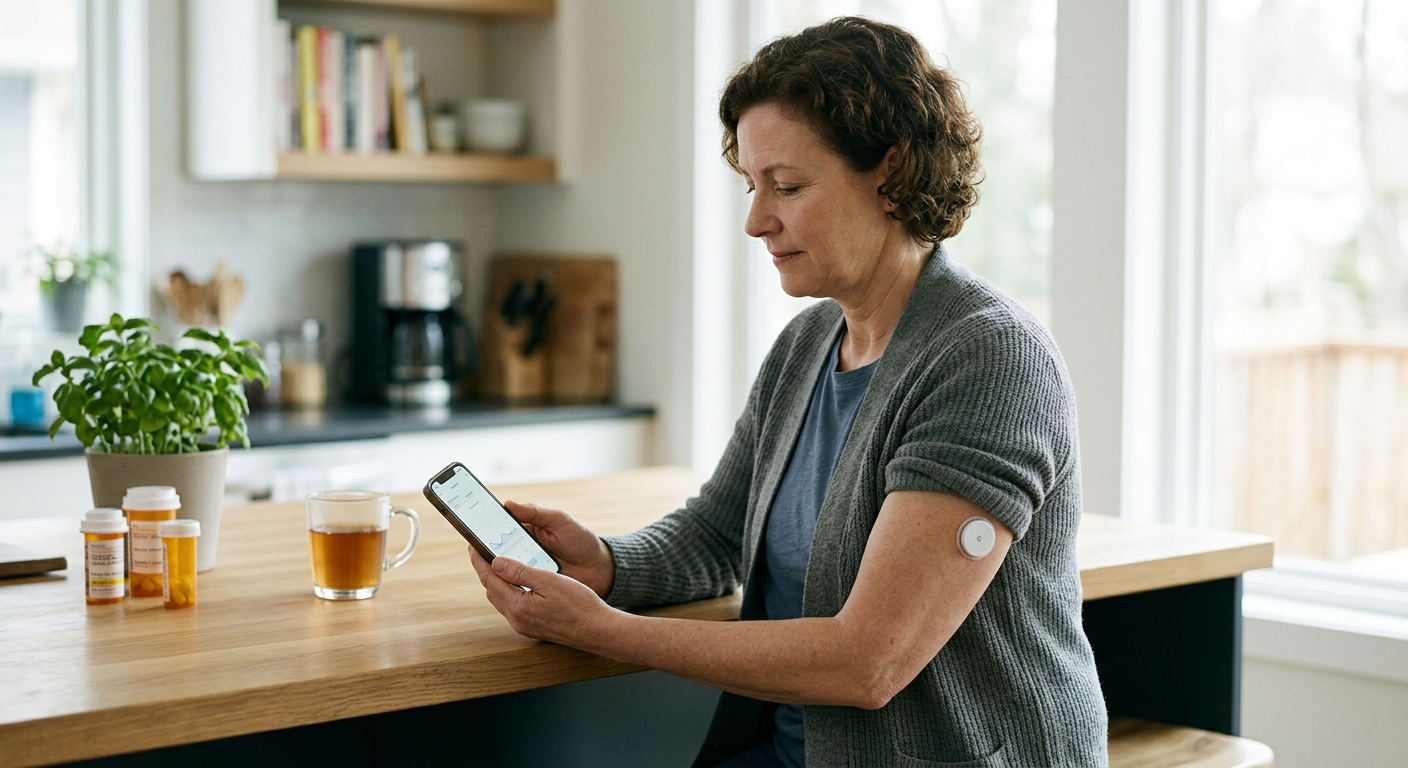
Smart glucose sensor, the setting behind this story.
Dexcom has officially made its Stelo continuous glucose monitor available without a prescription in the United States. This marks the first time a major CGM manufacturer has bypassed the doctor's prescription pad for a broad consumer audience. The device targets the estimated 25 million Americans with type 2 diabetes who do not use insulin, as well as health-conscious individuals.
The launch comes right on the heels of rival Abbott releasing its own consumer-grade Lingo sensor, which we flagged last week. Dexcom is pricing Stelo at 99 dollars for a two-pack of 15-day sensors. By making this accessible online, they are turning a highly regulated medical device into a direct-to-consumer wellness staple.
- Stelo is cleared for adults aged 18 and older who do not use insulin.
- The device offers a 15-day wear time with a smooth, low-profile design.
- Subscription options lower the cost to 89 dollars per month for users.
The read. Clinicians will face a surge of patient-generated glycemic data, requiring new triage workflows to separate metabolic curiosity from urgent clinical intervention.
MEDTECH Medtronic wins FDA approval for Simplera Sync integration

Insulin delivery pump, the setting behind this story.
Medtronic has secured FDA approval for its Simplera Sync continuous glucose monitor. This next-generation sensor is designed to integrate seamlessly with the MiniMed 780G automated insulin delivery system. The approval represents a major step forward in closed-loop diabetes management, eliminating the need for fingersticks or manual calibration.
The Simplera Sync is half the size of Medtronic's previous sensors and features an easier, family-friendly insertion process. By pairing with the MiniMed 780G algorithm, it automatically adjusts insulin doses every 5 minutes to prevent highs and lows. This launch strengthens Medtronic's position in the highly competitive advanced hybrid closed-loop market.
- Simplera Sync features a fully disposable design with no separate transmitter.
- The system integrates with the SmartGuard automated insulin dosing algorithm.
- FDA approval applies to pediatric and adult patients aged 7 and older.
The read. Medtronic is successfully closing the usability gap with Dexcom and Abbott by offering a highly streamlined, hardware-light closed loop experience.
AI Nvidia releases specialized generative AI microservices for healthcare

Computer server rack, the setting behind this story.
Nvidia has launched a suite of generative AI microservices designed to accelerate drug discovery, medical imaging, and genomics. Operating under the Nvidia NIM umbrella, these pre-built containers allow healthcare developers to deploy AI models on any cloud or enterprise server. The launch shifts Nvidia from a chip manufacturer to a foundational software layer for clinical AI.
These microservices include models for predicting protein structures, generating novel chemical compounds, and analyzing genomic sequences. By optimizing these complex models to run on Nvidia GPUs, the company is dramatically lowering the compute barrier for biotech startups. It is a clear bid to dominate the infrastructure of the next biological revolution.
- The catalog includes more than two dozen optimized healthcare microservices.
- NIM containers support popular models like AlphaFold2 and DiffDock.
- Partners like Amgen and Techcyte are already integrating these services.
The read. Platform giants are realizing that selling raw compute is no longer enough, they must deliver pre-packaged biological intelligence.
QUICK HITS
- Oura debuts the Ring Gen 4. The new smart ring features redesigned sensors for more accurate heart rate and sleep tracking. Oura
- Withings showcases BeamO multiscope. The handheld device combines an ECG, stethoscope, oximeter, and thermometer for comprehensive home checkups. Withings
- Apple AirPods gain hearing aid clearance. The FDA cleared Apple's software to turn AirPods Pro into over-the-counter hearing aids. FDA
- FDA approves Shield blood test. Guardant Health's non-invasive blood test is now approved as a primary screening option for colorectal cancer. Guardant Health
- FDA approves FARAPULSE PFA system. Boston Scientific's system uses tissue-selective electric fields to treat atrial fibrillation safely. Boston Scientific
THE INSIDER READ
The real story behind the over-the-counter CGM explosion is not about hardware, it is about data ownership. Right now, insurers do not want to pay for non-insulin CGMs, which is why Dexcom and Abbott are targeting the cash-pay wellness crowd. But the long-term play is gathering enough real-world behavioral data to prove to employers that early glucose tracking prevents expensive metabolic crises. If they prove that, reimbursement follows, and the consumer market becomes a massive enterprise funnel.
ONE MORE THING Will you recommend over-the-counter CGMs to your non-diabetic patients?
Reply to this email and tell us. We read every one.
See you tomorrow.
Dr. Dereck Mush, editor, The HealthTech Signal